Showing posts with label coal. Show all posts

It's GOOD that extraction of resources from public lands is down (if it is)

From Barack Obama's photostream on flickr
During the second presidential debate, candidate Mitt Romney accused President Obama of causing a decline in extraction of energy resources from public lands.  Although this accusation is misleading if not outright false, Obama could have derailed Romney entirely by agreeing with him and taking credit.

How about this exchange:

ROMNEY (what he actually said):  "As a matter of fact, oil production is down 14 percent this year on federal land, and gas production is down 9 percent. Why? Because the president cut in half the number of licenses and permits for drilling on federal lands and in federal waters."

OBAMA (what he could have said):  "As President and steward of our federal lands, I am proud of the fact that the resources on these lands are managed and conserved.  Our federal lands are meant not just for our generation, but for the next and the next and the next ten after that.  Governor Romney appears hell-bent on extracting every drop of oil, molecule of gas and lump of coal from our federal lands as soon as humanly possible. Right now the private sector is preferring to find resources on private lands rather than public.  That is good.  Since that's the case, I believe we should conserve the resources we have on our public lands for the future, when our descendants may need them more than we do.
So thank you, Governor Romney, for complimenting me on my conservative approach to use of our public lands.  I am proud that we are deliberately and carefully managing those resources for use of all Americans, present and future."

Clive Hamilton Says:

"In sum, the most important assumptions on which international negotiations and national policies are founded—that we can stabilise the climate at some level, that overshooting and returning to a lower target is feasible, and that we can accommodate 2 or more degrees of warming by adapting to it—have no foundation in the way the Earth’s climate system actually behaves. When one understands these facts, the state of political debate around the world takes on an air of unreality. Rich country policies—including cutting emissions by a few per cent and outsourcing most of the cuts to developing countries; waiting for carbon capture and storage technology to save the coal industry and continuing to pollute at high levels until that happens; planning the construction of new coal-fired power plants; and even, in Australia, entertaining the idea of exporting brown coal—are so at odds with the scale and urgency of the emission cuts demanded by the science as to be almost laughable. They reflect a child-like belief that climate change can be averted by ignoring the truth and hoping for the best, a form of wishful thinking whose costs will prove incalculable."

- Clive Hamilton
Clive Hamilton is Professor of Public Ethics at the Centre for Applied Philosophy and Public Ethics in Australia.

Even the IEA can't do math. No one understands growth!!

I was looking at the IAE statistics about coal, and I came across a couple of different statements that stand in sharp contrast.  First there was this:
Total recoverable reserves of coal around the world are estimated at 909 billion tons—reflecting a current reserves-to-production ratio of 129 years.  Historically, estimates of world recoverable coal reserves, although relatively stable, have declined gradually from 1,145 billion tons in 1991 to 1,083 billion tons in 2000 and 909 billion tons in 2008.  Although the decline in estimated reserves is sizable, the large reserves-to-production ratio for world coal indicates that sufficient coal will be available to meet demand well into the future. (emphasis mine)
Above this statement on the same page was this graph

accompanied by this statement:
The growth rate for coal consumption is uneven, averaging 1.1 percent per year from 2007 to 2020 and 2.0 percent per year from 2020 to 2035.

Monday What's on the Web: Coal Tattoo

Every Monday I highlight other bloggers or web contributors who are making important or interesting contributions to climate, sustainability, transportation or market transformation. Check back each week for another installment.
----------------------------
I like the name "Coal Tattoo" for this blog hosted by the Charleston Gazette.  I think it captures the idea of how coal creates a permanent mark on our landscape.  This blog covers the coal industry in pretty close detail.  Its primary author is Ken Ward, Jr., who has been covering the coal industry for about two decades.  Last fall, Joe Romm at Climate Progress singled out Mr. Ward as a "Game Changer" in the fight against climate change.  Here's the one-sentence description they use to describe the blog:
This Charleston Gazette blog attempts to build on the newspaper’s longtime coverage of all things coal — with a focus on mountaintop removal, coal-mine safety and climate change.
The blog is quite active and very up to date, averaging about one new post almost every day.  Here are some recent representative posts:

Big thanks to Ken Ward for the work he is doing on behalf of the people of the coal mining regions, the workers, and everyone on the planet who is dependent on a stable climate.


Making Mining Safer With One Simple Change

The news of a tragic coal mine explosion at the Upper Big Branch coal mine in West Virginia has been front-page news for a couple of days. As of the writing of this blog, at least 25 miners were killed with four still missing. Investigations show that the owner of the coal mine, Massey Energy, had thousands of safety violations, including some serious ones related to venting.
(More blog posts: Democracy Now, Open Secrets, Political Animal, and Think Progress)

The company as a whole has paid fines and been cited repeatedly for safety violations. There is, of course, an outcry for stronger regulation. Clearly this mine was operating unsafely. Federal coal mine safety chief Kevin Stricklin said, "We know it wasn't operating safely, or we wouldn't have had an explosion. It's quite evident that something went very wrong here. All explosions are preventable. It's just making sure you have things in place to keep one from occurring."

So we know it was preventable, yet the coal mine company did not prevent it. Why not? I believe it was primarily because it's just not in their financial interest to do so. The monetary impact is much too small. After a 2006 accident at a different mine that claimed two lives, the company was fined only $4.2 million. That's small pickin's for an enormous energy company like Massey. The mine in question, Upper Big Branch has been assessed only $2.2 million in fines since 1995--for more than 3,000 violations! They have only paid $791,327. Massey is contesting $1,128,833 in fines and has delinquent fines of $246,320. (More here)

I would suggest a very simple solution that would almost certainly reduce accidents in coal mines to almost zero immediately: a $100 million dollar fine for every loss of life in a coal mine. No exceptions. No "Acts of God." Every loss of life exacts this fine. Injuries would have smaller, but still significant fines. The only way this policy could work in practice would be to make it without exceptions. As soon as exceptions start to be made, then the whole system gets politicized and eventually it unwinds.

If Massey knew in advance that a major accident could cost them $2.5-$2.9 billion dollars (which is what this accident would cost), they would have done the risk management calculations that showed investing in safety would be well worthwhile. They would pull workers out of dangerous areas when each one is worth a potential $100 million. I suspect coal companies would take out insurance against major losses like this. That's fine. Unquestionably the insurance companies would make absolutely certain that the risks are completely minimized. They would likely do a much better job than the mine safety regulators, because they would have no ties to the industry and would have a very sizable and direct financial investment in risk reduction. They would be all over Massey constantly, making sure their insurance policy would not need to be paid out.

In real life, it seems impossible that such a simple system could be put in place. Instead there will be more and more complicated rules and regulations put into place. In the end, though, unless much, much larger fines are imposed and upheld, the companies will not make anything more than cosmetic or marginal changes. If a company knows that its entire existence may be threatened by a major accident, then it will act accordingly.

Coal for South Africa Now? No.

March 22nd's Washington Post contained an op-ed article by South Africa's Finance Minister, Pravin Gordhan. In it, he argues that South Africa needs World Bank funding to build 4800 Megawatts of coal-powered electricity generation to serve the development needs of the country and surrounding countries.

The article is a plea to the World Bank to support a $3.75 billion loan to help them make large capital investments in energy projects. He states that most of the money will fund the coal powered generation with about $750 million going to fund renewables and efficiency. Although the exact values are not stated in the article, it appears that well over 90% of the new generation that would be built from this money will be coal-fired. And any coal-fired plant is likely to remain in operation for decades--even as the climate continues to destabilize.

From the article: "A strong body of opinion holds that multilateral development banks should be discouraged from funding coal-burning power projects with carbon dioxide emissions that contribute to climate change. We share this concern but, after careful consideration, have concluded that the course we have chosen is the only responsible way forward. "

The World Bank should not acquiesce to this plea for several reasons:

1) Why does Minister Gordhan believe that South Africa is somehow more entitled to stray from the goal of eliminating coal-fired generation--or at least not fund it with international development funds--than any other country. One would doubt that he would suggest that the same exception be made for any country that could state, "If there were any other way to meet our power needs as quickly or as affordably as our present circumstances demand, or on the required scale, we would obviously prefer technologies -- wind, solar, hydropower, nuclear -- that leave little or no carbon footprint." "Affordably" being the key word. Coal is cheap almost everywhere, so any country could claim the same point of view as South Africa, and the developing world would just continue down an unsustainable path. I would ask Minister Gordhan which countries should be denied the type of funding he is requesting if they were to make a similar argument.

2) There is nothing in this opinion article that might be argued in another just like it ten years from now. If now is the wrong time for South Africa to start moving in a different direction, what assurance is there that a few years from now similar economic or energy-related pressures will not create an identical op-ed? If weaning off of fossil fuels is the right thing to do, then now is the time to start--not some undefined point in the future.

In February, the Minister gave his budget speech, in which he said, "Climate change and concerns over global energy supply present both challenges and opportunities for South Africa. Industries must be helped to manage scarce resources more efficiently and to reduce greenhouse gas emissions through appropriate pricing of energy. This is necessary to enable investment in sustainable technologies. Green economy initiatives will create new opportunities for enterprise development, job creation and the renewal of commercial and residential environments. This must play a part in our new growth path."

This op-ed seemingly ignores that sentiment, pleading that the World Bank fund this project, in which over 90% of the energy resulting from the project is devoted not just to fossil fuels, but the dirtiest fossil fuel of all--coal.

"(We) have concluded that the course we have chosen is the only responsible way forward. " he writes in today's op-ed. He is wrong. In fact, the only responsible way forward is to embrace the low carbon future instead of relying on the unsustainable technologies of the past.

Climate Decade in Review - Post 32: US Wind Capacity Increases by 14 Times

From 1999 to 2009, US installed wind capacity increased 14 times. It stood at approximately 2500 Megawatts (MW) in 1999 and had grown to more than 35,000 MW by 2009. A megawatt is 1000 kilowatts or 1,000,000 watts. A typical large coal-powered generator generates about 1000 MW. Wind is the fastest growing electricity generation technology and is rapidly coming down in price. In some locations it is as cheap or cheaper than coal.

Its big advantage is its obvious one: tapping the wind requires no burning of fossil fuels and thus no greenhouse gas emissions. Wind is expected to continue growing rapidly through the next several decades and will become more and more a significant solution to reducing the carbon intensity of our electricity generation sector.


=================
This is one in the series of "Decade in Review" posts on this blog that began in January 2010. These posts present climate-change-related events that occurred during the 00's, the warmest decade in recorded history.

Climate Decade in Review - Post 13: Wind Energy in US Grows Rapidly

August 2006 - Wind energy capacity in the United States reached 10,000 Megawatts (MW), enough to power 2.5 million homes, according to the American Wind Energy Association (AWEA).

Wind energy capacity at the beginning of the decade was about 2,500 MW, meaning that installed capacity quadrupled in six years. Wind energy was the fastest growing source of new electricity supply for the decade. By the end of the decade, total US installed wind capacity was approximately 35,000 MW--showing phenomenal growth of well over 30% per year.

Wind energy is one of the more attractive renewable energy options. Electricity generation from wind is entirely carbon free, and the growth of the wind industry during the 00's has helped bring prices down to be competitive with fossil fuel generation in many cases. Each kilowatt-hour of wind energy that replaces a kWh of coal-generated electricity reduces carbon dioxide emissions by more than a pound. (A typical household will use 25-40 kWh per day of electricity.)

=================
This is one in the series of "Climate Decade in Review" posts on this blog that began in January 2010. These posts present climate-change-related events that occurred during the 00's, the warmest decade in recorded history.

Warren Buffett and His Train Play: Good or Bad for Climate?

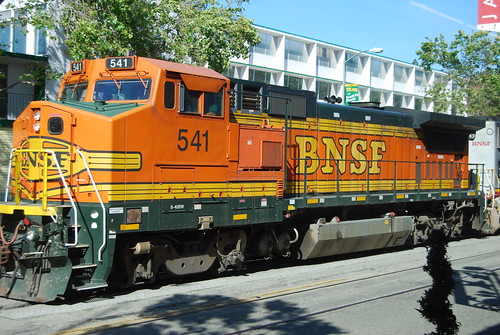
Back in November, Warren Buffett invested $26 or $34 or $44 billion to buy the Burlington Northern Santa Fe railroad (BNSF) (I saw several different values and didn't waste a lot of time trying to figure out which one was right). Last week Rolling Stone Magazine lampooned him for being a "Climate Killer." About a quarter to a half (again, conflicting figures) of BNSF's business is hauling coal, the antichrist of the climate change battle--300 million tons of it.

Elena Schor at World Changing blog presents both sides.
Green Energy Reporter reports on a couple of angles.

So what do you think? Is Warren a "Climate Killer" by buying BNSF or is he supporting a lower carbon future by investing in greener transportation?

I welcome your comments.

(photo attribution:http://www.flickr.com/photos/pfsullivan_1056/ / CC BY-ND 2.0)