Garnering Support for Traffic Enforcement Cameras

Last year, the Washington Post published an article about speeding and red-light cameras (Shudder speed, Nov. 5). The article cited many cases of citizens hating the cameras, voting against them, vandalizing them and otherwise being significantly opposed. Personally, I'm fine with the cameras, since I do not speed or run red lights, which is, of course, the ultimate weapon to use against them.

However, I do find myself in partial agreement with those who argue that the cameras are used to raise government revenues. At the end of the day, if everyone obeyed the rules, the cameras would collect no revenue, which is good and a laudable goal. However, until that day, the cameras are collecting fines. I believe that money could be strategically used to garner support for the use of the cameras themselves.

The article stated that DC collected about $36 million in revenue for fiscal year '08 from camera fines. If half of that is actually needed to operate the cameras and administer the fines, etc., that leaves $18 million in other revenues. I actually have no idea of these numbers: I am making them up. I would think that once the system is established, that the administrative costs would be much lower than this, but I don't know.

I suggest we take a lesson from the state of Alaska. Citizens receive a payment from the Alaska permanent fund, which is funded from minerals royalties. DC could do likewise, refunding each citizen their share of the camera excess revenues fund. Using my example above, each citizen would get a check for about $30. That's not an enormous amount, but it helps resolve two issues:
- Arguments about the cameras being primarily as revenue generators would become moot, since the city would not keep any revenues beyond the costs of administering the program.
- Support, particularly among law abiders and non-car owners would strengthen. I know that if my household was going to get a check every year from fining criminal drivers, I would be very supportive.

(cross-posted on Greater Greater Washington)

Warren Buffett and His Train Play: Good or Bad for Climate?

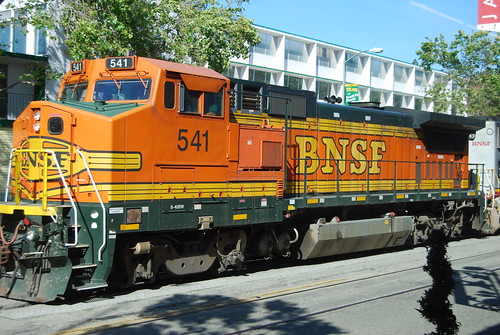
Back in November, Warren Buffett invested $26 or $34 or $44 billion to buy the Burlington Northern Santa Fe railroad (BNSF) (I saw several different values and didn't waste a lot of time trying to figure out which one was right). Last week Rolling Stone Magazine lampooned him for being a "Climate Killer." About a quarter to a half (again, conflicting figures) of BNSF's business is hauling coal, the antichrist of the climate change battle--300 million tons of it.

Elena Schor at World Changing blog presents both sides.
Green Energy Reporter reports on a couple of angles.

So what do you think? Is Warren a "Climate Killer" by buying BNSF or is he supporting a lower carbon future by investing in greener transportation?

I welcome your comments.

(photo attribution:http://www.flickr.com/photos/pfsullivan_1056/ / CC BY-ND 2.0)

To Bollard or Not to Bollard: That is the Question

A few weeks ago, the new trail connection from Harrison Street to the Custis Trail was completed (see post here). As you can see from this photo, there is a bollard installed at the end of the connector by the sidewalk on Harrison Street. That got me thinking about bollards on trails. Having given it some thought, at least for the areas where I generally ride in DC and Northern Virginia areas, I think they are a waste of money and effort, serve no purpose and sometimes create a hazard.

The picture above shows the Harrison St. end of the new connector. Note the bollard installed in the middle of the trail. Presumably it is there to prevent cars from driving on the trail. (Please note that this picture was taken before this project was ultimately completed. There is a curb cut that will be built here to allow access to the trail from the street.) Other bike riders who read this blog are welcome to comment, but in all my years of riding the trails, I have never encountered any unauthorized vehicles on the trails. Maybe that means the bollards are working!? Well, except for the fact that there are numerous locations that have no bollards, and I've never seen vehicles in those areas either. Here are a couple that are near my house (click on any photo for a larger version):

Note that this one has the post hole and base, which presents a hazard in and of itself. This bollard has been missing for years along this well traveled road, yet I have never noted any cars turning onto the path.

Here's another. This one used to have a bollard, and one can see where it was removed and paved over to provide a smooth surface (although it's difficult to see in the photo, sorry). I have never encountered any cars trying to drive on this trail.

Here's a W&OD crossing in Loudoun County. Note there is no bollard even though the trail is easily wide enough to accomodate a motor vehicle.

Here's a case where the bollard proved to be an impediment. The plow was unable to plow the final 30 yards to the sidewalk after the recent snow, because this bollard was in the way.

I have saved the dumbest one for last. A few months ago, this new connection was built along the W&OD in Fairfax County near milepost 10. It connects the trail to a residential street called Malraux Drive (link to map here). There are bollards on both ends of the connector! And not small ones, either. Both of them are heavy steel construction that probably cost hundreds of dollars to install. One could make an argument for the bollard at the other end, where the connector meets the street, but this one--at the connection of two trails--is senseless. In fact, it is worse than senseless: it's a hazard. I remember one day when I was pulling my daughter on the trailer bike, I got very nervous that I would smash her hand on the bollard as I negotiated this corner. I didn't thankfully.

So all in all, I think that bollards are one of those institutional inertia issues. They've always been put in, and no one questions why. So now I'm questioning why. Here are the key points of consideration:
- Based on my experience, they seem to address a non-existent problem
- They cost money, which could be saved if they were not installed. Perhaps the savings could be used for better trail signage
- They can present a hazard to cyclists
- They require maintenance, which is an additional cost. Or if not maintained, they break or eventually are removed and/or lost.
- They can impede the movement of authorized vehicles, such as snow removal, maintenance or emergency vehicles.

My recommendation would be that bollards not be included in future trail improvements. Should it turn out in the unlikely event that unauthorized vehicles become a problem, the bollard could be installed at a later date.
--------------------------------
There are three consecutive bollards in this photo along one short section of trail.  This trail has since been modified, but there is still one bollard sitting in the middle of the trail at a point where there is no intersection of any kind.

My daughter ran into this bollard, which is a bad design.  There are actually two bollards here, one on each side of the trail in the exact center of the lane of travel!!!  Talk about a hazard.

Tyson's Corner Circulator Buses - Take a Book Along

This recent article in the Washington Post raised the important question of providing transportation within the Tysons Corner area to supplement the new Silver Line Metro service. Even with the new Metro stations, Tysons will remain a spread-out, edge city with long distances between buildings, large parking lots and uncomfortable walking infrastructure, at least in the short term. Even the most visionary land-use plans to transform Tysons to a more pleasant, transit-oriented development, idyllic urban space will take at least a generation to realize, if not longer.

In the meanwhile, people will need to get from the Metro stations to their destinations that may not be within walking distance or may be difficult to walk to. Hence the proposal to run circulator buses as described in the article. The article also points out that there is no money for the buses.

Without some sort of supplemental transportation, a significant part of the value of building the Silver Line will be lost. Currently there are thousands of reverse commuters from DC, Arlington and Alexandria who work in Tysons. Unless their work places are right near the new stations, many of them will continue to drive. After all, there's no HOV requirement in the reverse direction, most parking is free, and it will be so much more convenient to go right to your work place.

Even the buses themselves will be significantly suboptimal. They will need to deal with the same traffic as the cars. Passengers will have to wait for them at both ends. If your stop is later on the route, you'll have to sit through a half-dozen earlier stops. For a lot of situations, it might take fifteen minutes to get from the Metro station to a building only a mile away. That's as long as it would take to drive all the way from the Potomac River to the building. Some sort of supplemental transportation is needed, but circulator buses--unless they can somehow be separated and given priority--will be barely adequate.

The Tysons Land-Use task force recommends that eventually that be the case:
"The vision of a transformed Tysons calls for transit services linking the four future Metrorail stations with the rest of the Urban Center. As described above, these services may begin as shuttle buses serving Metro stations and evolve over time. A second phase may be buses operating in mixed traffic. A third phase may be buses operating on exclusive rights-of-way, followed by a fixed guideway system operating on exclusive rights-of-way." (from Transforming Tysons, Fairfax County's Department of Planning and Zoning, Feb. 2009)

What if Tysons were to leap forward to that vision now--become a visionary leader and try a radical departure from the inside-the-box transportation thinking? I believe a PRT system in concert with the Silver Line could be a catalyst for much more rapid and significant transformation of Tysons. It solves the last-mile problem elegantly. One could travel between any two points, non-stop, within Tysons in less than ten minutes. In and of itself it would attract people and businesses to Tysons. It's possible it could even pay for itself through revenues and through support from businesses (think hotels) that would support having it serve their building directly. I don't know how much support for the circulator buses might come from the businesses, which the Tysons task force has suggested. I suspect not much. It also eliminates the costs of phasing buses in and then out. It starts with the fixed guideway system from the beginning.

As Lincoln said "As our case is new, so we must think anew and act anew." Buses are not new. Even streetcars are not new. Why not think anew and act anew? Many people are thinking hard about how to make Tysons new. Why not take grasp of a new vision of how to make Tysons an extraordinary place--not just the old Tysons, only better? I think creating a comprehensive PRT system in Tysons will create an example that could be imitated in scores of other places in the region and the nation, creating a true transformation of our urban spaces and our transportation paradigms.

Explain me to me re Climate Change Hoax

As I surf the blogosphere and read about climate change, I see many, many comments about a "climate change hoax" or fraud (examples: here, here, here, and lots of other places).

Whenever I read this I take pause and wonder hard about me. I've spent almost twenty years now working to reduce the risks of climate change. If the whole thing is a hoax, then I'm either actively participating in it or I've been bamboozled by the hoaxers. If it really is a hoax, then I can't explain me. Could someone please explain me to me?

Let's take the first one: that I'm participating in it. I don't recall ever being contacted by anyone--not Al Gore or any of his people, not the UN, not the National Academy of Sciences, not Nicholas Stern. Not anyone. No one has ever talked to me about helping to perpetuate any kind of fraud or hoax. I guess a true cynic would claim that I am lying, and I suppose I can't prove that I'm not. You'll just have to take my word for it. Nonetheless, I've had the pleasure of working with scores and scores of others in the environmental field, and not a single one has ever mentioned they were part of a hoax or fraud. Nor have any of them mentioned being contacted by any of the aforementioned or anyone else to take part in this elaborate hoax. In all my years, I've never come across someone rubbing their hands together saying, "bwa-ha-ha" in a conspiratorial tone. Who are these hoaxers?

Maybe I'm just going along with the hoax because I'm profiting from the illusion of climate change. That's a common accusation, often directed at Al Gore. Same problem as before when it comes to me, though. When I examine myself, it doesn't add up. I've got an MBA from a top tier business school. I could make a lot more money in management consulting or any of a number of fields. In truth, I have actually made a lot less money over the last couple of decades by focusing my career on this issue. Clearly, money is not my motive. I don't know about Al Gore; but again, he's never gotten in touch with me to help him out or share in his profits. So what's in it for me?

And I think about James Hansen. He's a government employee. He isn't being paid any more to push for strong action on climate. What's his motivation? He's not profiting; there's certainly lots of work he could do on other issues; and he even put his job at risk during the Bush administration. I don't get it. If there's some sort of hoax or fraud afoot, what's in it for him?

Investments? I don't know about James Hansen, but speaking for myself, I haven't yet set up my portfolio in a way that would take advantage of economic changes being affected by climate change and the actions to fend it off. I probably should, but I haven't up to now. So I'm not currently profiting. So money's not my motive. Explain me to me.

Many of these commenters also put forth the claim that we environmentalists are seeking to control the world, set up an oppressive world government that will deny their liberties and tax all their money away in the process. Yet when I examine myself, I find myself agreeing with them: I don't particularly care to pay unnecessary taxes, and I'm not a fan of oppressive government, either--nor do I have any interest in trying to take away people's personal liberties (I am, after all, a person, too; and I like my personal liberties). So if that is our goal, why am I doing it? Explain me to me.

So if I'm not actively part of the hoax, then I must be some sort of brainwashed supplicant to the cause. I've been bamboozled by the hoaxers! However, I examine myself again, and I find that a difficult argument to believe. I've never sent money to Nigeria nor been fooled by other hoaxes or scams. Perhaps I'm self-deluded and really am brainwashed, but why would it be only on this one single issue? If I'm brainwashable, then one would think others would take advantage of me. After all, there are scams everywhere all the time, yet I've never fallen victim to any of them.

And how about those scores of colleagues, friends and coworkers also working on the cause? Have they all been brainwashed, too? Yet most of them are very smart, if not brilliant. It's difficult for me to believe that they've all somehow been fooled by a secret and elaborate hoax of unknown origin.

So this whole idea of climate change being a hoax or fraud intended to create an oppressive world government and destroy our economy and freedoms is very difficult to reconcile with me. I can't explain me to me. If you believe that climate change is a fraud or hoax, please help me understand how I fit in.

Why two degrees really matters

My friend, Jon Koomey, said I should pass this along to all who may be interested. I think it's a remarkably intelligent article, so I am passing it along.

by Jonathan G. Koomey and Florentin Krause

When the countries of the world meet for climate negotiations in Copenhagen this month, they will discuss how to prevent global temperatures from increasing more than 2 degrees Celsius (3.6 degrees Fahrenheit) above pre-industrial levels. This warming limit, accepted in principle by the leaders of the G8 countries in July, is more than just a number—it represents a way to think about the climate problem that can help us develop and evaluate options for solving it.

The current trajectory for greenhouse gas emissions would move the Earth by the middle of this century well outside the temperature range in which humanity evolved, marked by the 2-degree limit. This trend increases substantially the risk of dangerous, irreversible, and, perhaps, catastrophic changes in the global life support systems upon which we all depend. As the White House Science Advisor John Holdren aptly puts it, we’re “driving in a car with bad brakes towards a cliff in the fog.” The 2-degree limit is like a road sign warning us to avoid the cliff ahead.

Defining a warming limit implies a greenhouse gas budget, which is an upper limit to our cumulative emissions over the next 50 to 100 years. Such a budget encapsulates our scientific understanding of how emissions interact with the Earth’s climate and affect global temperatures. Some of the most significant greenhouse gases, like carbon dioxide, stay in the atmosphere for many decades, which is why the budget is defined over the long term.

Acceptance of an emissions budget should focus the climate talks because it encourages discussion of how to allocate that budget among countries. Many argue that developing countries like China can legitimately claim much of the emissions budget because they have large populations and have consumed relatively small amounts of fossil fuels thus far. But developed countries like the United States can’t phase out greenhouse gases overnight. In addition, many emissions from emerging economies are attributable to the manufacture of exported goods. Discussion of a specific budget will help negotiators balance more effectively these complex issues of feasibility and equity.

The warming-limit approach is analogous to how businesses conduct planning under uncertainty: Set a long-term goal, then work backward to determine how to achieve it, modifying plans dynamically as developments dictate. It’s operationally much more useful than a target for a single year. In fact, it can be used to derive such targets over many years, once the budget is allocated to developed and developing countries. It also has advantages over conventional, forward-looking policy analyses, which are hamstrung by the inherent limitations of economic forecasting models in accurately predicting the future.

Using a warming limit in this way prompts us to ask questions like “What are the least expensive options for meeting the target?” or “How many emission-free power plants must be built per week to meet the target, and how much capital would that require?” or “How fast must energy efficiency improve to meet the target given projected economic growth?” The answers to such questions help us identify the options that are most cost-effective, feasible, and desirable, and allow us to envision the kind of world we want to create.

The 2-degree warming limit is demanding—it implies halting growth in absolute global greenhouse gas emissions within the next decade, with reductions of at least 50% by 2050 compared to 1990 levels, and larger reductions soon afterward. It also has other implications that most policy makers do not yet fully appreciate:

(1) We shouldn’t wait: Delaying action only eats up the emissions budget, locks in emissions-intensive infrastructure, and makes the required reductions much more costly and difficult later. Early action also brings the costs of technologies down through economies of scale and learning-by-doing, a fact usually ignored by ill-informed climate skeptics.

(2) We need to move quickly on many fronts: The rate of change in energy systems needed to stay within the budget will require broad societal mobilization, rapid innovation, and major investments in science, technology, and education not unlike those undertaken by the United States after the USSR launched Sputnik in 1957. One key to rapid change will be the development of new technologies that consumers prefer even if they initially carry a higher price—much like early fossil fuels, such as kerosene, were preferred to whale oil for lighting in the mid-1800s;

(3) We can’t burn it all: More than half of the Earth’s remaining economically recoverable fossil fuel reserves must be kept in the ground to achieve climate stabilization (or, if burned, their carbon emissions will need to be stored securely). A price on carbon and significant reductions in the costs of low carbon technologies are the two most important means for achieving this difficult goal.

The 2-degree warming limit provides guideposts for a real solution to the climate problem, yielding insights available from no other approach. We’ll need to apply these insights, invest in a large portfolio of promising options, fail fast, and learn as rapidly as we can. There’s simply no more time to waste.


Jonathan Koomey is a Visiting Professor at the Yale University’s School of Forestry and Environmental Studies, and Florentin Krause is a researcher living in Richmond, California. Krause was the principal investigator and Koomey was one of two other coauthors of the first systematic attempt to evaluate the implications of a warming limit-based approach to addressing the climate problem (Florentin Krause, Wilfred Bach, and Jonathan G. Koomey. 1989. From Warming Fate to Warming Limit: Benchmarks to a Global Climate Convention. El Cerrito, CA: International Project for Sustainable Energy Paths. http://files.me.com/jgkoomey/9jzwgj). It was republished in 1992 as Florentin Krause, Wilfred Bach, and Jonathan G. Koomey. 1992. Energy Policy in the Greenhouse. NY, NY: John Wiley and Sons.
===================
This post was reposted from Climate Progress. That posting includes footnotes and references which you may find useful.

School Choice Improves Education

As a parent of two school-aged children and a resident of Arlington County VA, I am pleased and impressed with the choices the county offers to parents. Truthfully, it's almost an embarrassment of riches. I sometimes think about my siblings in Colorado. In their case, their children either go to the neighborhood school or can choose to go to a private school. There is little option to choose among the public schools within their district. Nor do the schools offer differing programs from school to school anyway. From my viewpoint, I believe this surfeit of choice can make a positive difference in how schools perform, and I would encourage every school district, and even Arlington County, to expand on this model.

Arlington, offers a number of choices to students at all three levels: elementary, middle and high school. Because my daughter is in 5th grade, we are currently making our decision about her middle school for next year. So this post will look at middle schools in particular. (Future posts may cover other aspects of Arlington's school system.)

Arlington has five middle schools: Gunston, Kenmore, Jefferson, Swanson and Williamsburg. It also has a special program at H-B Woodlawn, which for all intents and purposes, is another middle school/high school combined. Four of these offer special programs of some kind. I think the other two should also, as I discuss below.

- Gunston offers the Spanish Immersion continuation program for students who attended one of the Spanish Immersion elementary schools (Claremont or Key, which is the school my daughter attends as did her brother before her). Our experience has been that the majority of elementary school immersion students continue at Gunston. The immersion students make up about 1/3 of the student body, with the rest coming from the neighborhood. This choice is really only available to those who participated in the elementary immersion program--or possibly students who live in Spanish-speaking households.

- H-B Woodlawn Secondary Program is a countywide program which selects students by lottery. It's unique in more ways than can be described here; you may click on the link for more details.

- Jefferson Middle School is an International Baccalaureate Middle Years Programme (IBMYP), having received authorization from the International Baccalaureate Organization (IBO) in the spring of 2007. (Note that Washington-Lee High School also offers an IB program.) Although this program is not specifically designated as available countywide, it is possible for parents to transfer in from elsewhere in the county, because Jefferson currently has the smallest enrollment of the five middle schools. However, the county does not provide transportation for out-of-area students.

- Kenmore is an arts and technology focus school, which serves as both a neighborhood school and is also open to students from across the county?space permitting. It integrates the arts (drama, music, dance, etc.) into the learning process.

- Swanson and Williamsburg are pure neighborhood schools with no special programs. Students could theoretically transfer in--space permitting--but it's not clear why they would, unless, say, a family moved within the county and wanted to stay at the same school. We live in the Swanson area.

We have now had two occasions, once with each child, to attend middle school informational sessions. By and large, they are impressive: Arlington Schools are excellent. My wife and I have both noted, though, that the presentation from Swanson--our home school--was decidedly less noteworthy than the others. Both of our children were underwhelmed by those presentations but truly impressed with Gunston and Kenmore presentations. I have a theory about this.

I believe that the schools with specialized programs perceive themselves as special. Swanson and Williamsburg perceive themselves as the neighborhood school striving to be the best they can be, but no different than any other middle school that is serving its neighborhood. When I attended the Swanson presentation for my son, about 90% of what was presented was about middle school in general and about 10% was about Swanson in particular. For Gunston, though, it was about 25% middle school oriented and 75% about Gunston and how it is unique. The pride they took in their special status oozed from the principal, the teachers and every student.

In a similar vein, a friend of mine with a 5th-grade student recently took a required tour of one of the two neighborhood middle schools with the principal. If you want to transfer your student out of your home school to one of the others, you have to get a form signed by your home school's principal and attend a tour and orientation. He was there to get that done, so he could move his daughter to another school. He told me that the principal spent most of the time trying to convince the attendees to not leave for another school. But without some sort of special status or program, she didn't have much to offer.

I believe that giving a school a special mandate or program creates an environment that spurs that school on to do more and aspire higher. I think Arlington would benefit from creating special programs at the remaining two middle schools, Swanson and Williamsburg. Give them a special status and they will make themselves even more special. They'll strive to attract students through their achievements and programs rather than just their geography. Every middle school in the county would be available to every student, with each providing a special program of some kind. There would be even more choices but also better results and outcomes, I believe.

Obviously a system would have to be devised to even out attendance with capacity, but I think that is doable. Arlington benefits from its compact geography, making it easier to provide transportation to students countywide--something that would clearly be more difficult in places like Fairfax, Loudoun, Montgomery or Prince George's Counties or even the District.

School Kids Getting Smarter

Swanson bikes 3 Last year about this time I posted on the bicycles at Swanson Middle School. On the day I took that photo in 2008, there were thirteen bikes parked at the school. The picture here was taken in mid-October 2009, and shows fourteen bikes (and a scooter that you can't quite see). So that's a slight uptick from last year. I was pleased to see that there are still kids who are smart enough to know that riding a bike to school is probably the quickest way--allowing them to sleep in longer in the morning and get where they want to go sooner in the afternoon.

A couple of days later I was walking by again, and there were eighteen bikes! Swanson bikes 2I guess they are getting smarter. Now it's time for the school to install a couple more racks, because there are only ten racks with room for two bikes on each--twenty total capacity.

(Click on photos for larger versions)

Demographics: Friend or Foe?

The Economist published an article recently about falling fertility rates in many developing countries (Falling Fertility, Oct 29). I found this article to be one of the more straightforward looks at how demographics fits in with environmental issues--particularly climate change.

I've written on demographics before (here related to environment and here related to transportation infrastructure). Many articles I see associated with low fertility in countries like Italy and Japan focus on how that is a problem because of how it strains their economic structure. Other demographic articles that deal with environment focus on how our large and growing population has overstrained our planet. Agreed.

What this article points out is fertility rates are dropping amazingly fast in many countries. For instance from 1984 to 2006 it dropped from 7 to 1.9 in Iran. They accurately use the word "astonishing" to describe that. Fertility rates are anchored in social norms, so it's difficult to imagine social trends changing faster than that. In fact, I have a difficult time imagine them changing that fast period.

I am going to quote the last three paragraphs from the story directly, because it articulates our position here on the earth better than I ever could:

"In principle, there are three ways of limiting human environmental impacts: through population policy, technology and governance. The first of those does not offer much scope. Population growth is already slowing almost as fast as it naturally could. Easier access to family planning, especially in Africa, could probably lower its expected peak from around 9 billion to perhaps 8.5 billion. Only Chinese-style coercion would bring it down much below that; and forcing poor people to have fewer children than they want because the rich consume too many of the world’s resources would be immoral.

If population policy can do little more to alleviate environmental damage, then the human race will have to rely on technology and governance to shift the world’s economy towards cleaner growth. Mankind needs to develop more and cheaper technologies that can enable people to enjoy the fruits of economic growth without destroying the planet’s natural capital. That’s not going to happen unless governments both use carbon pricing and other policies to encourage investment in those technologies and constrain the damage that economic development does to biodiversity.

Falling fertility may be making poor people’s lives better, but it cannot save the Earth. That lies in our own hands."

Carbon Offsets Not a Mirage Post 2

Last week I posted in response to an article in the Washington Post by Laurie Williams and Allan Zabel entitled Cap-and-Trade Mirage.

I countered their contention that employing cap and trade would not result in the required emissions reductions to get us started down the path to a low-carbon economy. They opined that cap and trade would not jumpstart a revolution in renewable energy; I countered that it would spur efforts in energy efficiency, which represent a significant untapped opportunity.

The larger point they made in the op-ed was that the inclusion of carbon offsets in the proposed climate legislation in both the House and Senate would "guarantee failure" of the bills. That's a pretty strong contention: "guarantee failure." I could not disagree more, and I am supported in this opinion by Dan Lashof, director of the climate center of the Natural Resources Defense Council.

Here's a quick primer on carbon offsets:
Carbon offsets represent emission reductions that occur in one place but are credited somewhere else, generally because they are paid for by the entity in the "somewhere else." For instance, landfills that are not required to capture the methane their waste produces as it decomposes generally will vent that methane (a potent greenhouse gas), because it's cheaper than putting in place the technology to capture it. However, an outside investor could help finance that technology in exchange for the emissions reductions that will result. Those emissions are "carbon offsets," and they can be used to "offset" emissions reductions that would otherwise be required by the financing entity.

It is easy to find criticisms of carbon offsets. Some people have compared them to Medieval Indulgences--just a way to assuage guilt. Others, including Williams and Zabel, claim that they don't actually result in any emissions reductions because of "additionality" problems or poorly designed or regulated projects. Both of these are issues worth addressing, but they are wrong that these issues will result in failure. On the contrary, by instituting strong offset provisions, these bills will accomplish more emissions reductions faster while potentially helping to build momentum for greenhouse gas reductions across the economy.

Let's take "additionality" first. What is "additionality?" Simply, it's the term used to describe whether a project would have happened anyway. . ."additional." This is a simple idea, but fairly difficult to pin down in any particular circumstance, since it requires the ability to know what would have happened instead. In many cases, that might require mind reading. The fact that additionality is difficult to know perfectly does not mean that every project is worthless or that it's not possible to make intelligent judgments. Quite the opposite, in fact. Every carbon offset certification organization has well thought out additionality requirements.

While I was at Carbonfund.org we partnered with a not-for-profit organization called Paso Pacifico on a project that was certified by the Climate, Community and Biodiversity Alliance (CCBA), called Return to Forest. This project is about as additional as one can imagine. Former pastureland that was lying fallow was restored to forest through carbon offset financing from Carbonfund.org's donors. Without this funding, the forests that are growing there now would not exist. They are "additional;" they could not have possibly occurred otherwise. Better even is that CCBA has additional requirements to benefit local communities and biodiversity. So this project, which was financed through carbon offsets, provides significant ancillary benefits at no additional costs. CCBA, as well as other certifying organizations, also has strict requirements to make sure plans and finances are in place to manage projects for decades into the future.

I personally like forestry projects even though there are dissenting views on this subject--even from other environmentalists (like Joe Romm). My reasoning comes down to one simple idea. Half of all the forests that existed 8,000 years ago are gone. We have to put them back as one of the key strategies in our battle against climate disruption. We have to put them back. If carbon offset financing helps us do that (and it does), then let's go! If we're worried about permanence (they might burn down or be killed by disease), we can compensate by underestimating the climate benefits for each project such that in total the climate benefits are still better than originally estimated. (Also, project insurance--which doesn't really exist yet--could help overcome this issue.) Listen, no one is investing the kind of money needed to reforest the planet on the scale required just through charitable efforts or even national and international government investments. Well designed carbon offset schemes can help.

Return to Forest is just one example of a project that is clearly additional. Additionality can be somewhat subjective and has been the topic of much debate for years in offset circles. That's why offset certifying organizations have worked so hard to put in place additionality requirements. Perhaps they are not perfect, but by dealing with this issue, they have helped solidify confidence in the markets for carbon offsets.

I used a forestry example, but projects of all types can meet additionality criteria. In fact, Joe Romm himself, who has generally been against most offset schemes, comes out in favor of offsets in Waxman-Markey, because they meet both additionality issues and are fraud resistant.

Which is the other issue Williams and Zabel bring up. They point out a couple of examples of dubious projects that don't actually reduce any emissions or are fraudulent. Well, sure, I can find examples of fraud everywhere, but that doesn't indict the entire system. Just because some bad mortgage loans were made doesn't mean we scrap mortgages entirely as a way of financing homes. No, we just improve our systems to reduce the problems and keep the benefits. Same with offsets. Williams and Zabel say that these problems "cannot be solved by certification or verification processes." They offer no evidence of that; they just baldly assert it. Well, I can say au contraire--we have the tools to overcome issues of fraud, measurement and additionality, and they are already being used in the offset markets and are continuously being improved.

So I must respectfully disagree with Williams and Zabel. Offsets will help meet our reduction targets at lower costs while also putting money towards a wider variety of projects and strategies than would occur without them. Insomuch as international offsets are also allowed, that will help spur investment in other places in the world, too--which is a good thing for fighting climate change.

Carbon Offsets Not a Mirage, But an Important Tool

On Halloween, the Washington Post published an op-ed article by Laurie Williams and Allan Zabel entitled Cap-and-Trade Mirage. Williams and Zabel are EPA employees, as I once was, too. The article made a couple of assertions about strategies for addressing climate change that are, in my opinion, wrong. The major point they attempt to make is that our cap-and-trade legislation is doomed to failure because it includes carbon offsets. Tomorrow I will counter their assertions about offsets, but today I will address an earlier point they make in their article.

Here's a quote:
"Confidence in the certainty of declining caps is based on the mistaken assumption that cap-and trade was proven in the EPA's acid rain program. In fact, addressing acid rain required relatively minor modifications to coal-fired power plants... In contrast, the issues presented by climate change cannot be solved by tweaks to facilities; it requires an energy revolution through investments in building clean-energy facilities. The biggest obstacle to this revolution is that uncontrolled fossil fuel energy remains much cheaper than clean energy.

Cap-and-trade alone will not create confidence that clean energy will become profitable within a known time frame and so will not ignite the huge shift in investment needed to begin
the clean-energy revolution."

The energy revolution they claim is needed is required--eventually (and, I would agree, the sooner the better). But right now we already possess the tools and technologies to reduce our carbon emissions by up to 40%--and at a profit. It's called energy efficiency. Steven Chu, Secretary of Energy, has reduced the energy use in his house by almost 50% with relatively small effort (as he blogged on Huffpost). Similarly, with a lesser effort than he, I have reduced the energy use in my house by an estimated 20-30% with relatively minor investments. And there's lots more I can and should do. Most buildings can reduce their energy use by 30% or more at a net-zero cost. Buildings alone account for 40% of our greenhouse gas emissions, so we can get 12% reductions in total emissions without doing anything else than profitably improving efficiency in buildings. California has held emissions per person constant for almost 30 years while it's rising everywhere else in the US.

The United States emits about double the greenhouse gases per dollar of GDP as Japan. That's not because Japan is a generation ahead of us in clean energy generation. It's because they are a generation ahead of us in using the currently existing energy efficiency opportunities that are right in front of us. Because energy is more expensive there, they have learned to be more judicious and smarter with it.

Cap and trade will make energy more expensive here--although probably not by as much as Williams and Zabel (and I for that matter) would like it to be to force a truly rapid revolution. However, the cap will compel companies to find ways to reduce their emissions. It's true that if the cap were declining rapidly and the only solution were renewable energy, that the concept might fail, but that's not the case; renewable energy is not the only solution. We can easily meet the emissions targets in Waxman-Markey or Kerry-Boxer with technologies and practices that are already widely available. At the same time, these bills contain additional incentives to help push investment towards the development of more renewable energy above and beyond what the cap-and-trade component of the bills might drive by themselves.

So Williams and Zabel are wrong that we cannot take the lessons from Acid Rain and apply it to carbon emissions. In fact, at the time the Acid Rain Program was put in place, many industry studies assumed that it would require very expensive scrubber technology to meet the emissions targets required. The power plant owners discovered that, in many cases, they could meet those targets more economically by switching to a different fuel, or shutting down the dirtiest plants. The costs, it turned out, were much lower than even the most optimistic predictions of environmentalists and only 10% the costs that the industry had predicted. Not only that, but for much of the history of the program, the utilities have actually emitted far less than the cap required, because they were able to find other ways to do so that were cheap.

Williams and Zabel are similarly assuming that there is only one solution and that solution is untenable. The beauty of using cap and trade is that other solutions will also be found, in many cases ones we may not have thought of. In this case, we don't even have to be surprised, though, because the most obvious and cheapest solution is already staring us in the face. Put the cap and trade in place so we can unleash the energy efficiency revolution.

International Day of Climate Action - In the Trenches

Saturday was the International Day of Climate Action organized by 350.org. Check out their website for the photos, which are inspiring.

I personally participated in three different events. The site claims over 5200 events in 181 countries, which is enormously impressive, but might be padded slightly based on my own experience.

The first event took place in the Twittersphere. Between noon and 1:00 PM EDT, everyone with a twitter account was to twitter to Barack Obama this message:
"@barackobama USA MUST formally adopt the 350ppm CO2 target at Copenhagen 09 – the ONLY WAY to prevent runaway climate change NO EXCUSES!"

For those not familiar with Twitter, the "@" sign is used to direct a message to a particular twitterer, but all your followers can see it. The idea was that the White House would receive literally thousands of tweets with this message in it. Unfortunately, by my count, fewer than 200 people actually did it (including me; you can follow me on twitter at @steveoffutt).

Second was an event at Bourbon Coffee at 21st and L. I wanted to join the big rally at the White House at about 4:00, which I was biking to, so I passed literally right past the coffee shop. This event was described on the site thus:
Come to Bourbon Coffee on at 21st & L Streets NW at 3:50 pm! Join other like-minded 350.org supporters in grabbing an afternoon coffee drink.
I used this as an excuse to get a cup of coffee to take with me to the rally. The girl behind the counter when I got there (at 4:03) had no idea what I was talking about. Good thing I stopped in, so at least that event had one participant.

Finally I got to the rally at the White House. This event had started in Malcolm X Park at noon with entertainment, speeches and other activities. The crowd then marched down 16th St. to Lafayette Park, which is where I met up with them. They got soaked on the march, because it was raining like crazy (I got a bit wet, too, on my bike).

This event was more successful. Even with the rain, there were probably at least 1000 people there at the White House with a 350 foot banner, encouraging the administration to take a strong leadership role in the Copenhagen negotiations in December.

I hope you were able to participate in an event. If not, keep an eye on 350.org for more opportunities to help in the effort to avert dangerous climate change.

International Day of Climate Action This Saturday, October 24

Denali_logo
This Saturday, October 24, is the International Day of Climate Action organized by 350.org, an organization co-founded and directed by famous environmentalist, Bill McKibben. 6055 The number 350 represents the maximum CO2 concentration the atmosphere can hold without causing significant climate disruption according to highly regarded climatologist, James Hansen. As of the writing of this blog, more than 4000 events in 170 countries have already been organized. Join an event and show your support for strong action on climate from our political leaders.

More Silver Line Dreaming

I live not far from the East Falls Church Metro in Arlington VA, and so I have seen some of the actual construction of the Silver Line (Metro's 17-mile extension to Dulles Airport)--which certainly makes it more real after many years of talking and debating.

Recently there were a couple of posts discussing the Silver Line and a discussion of a high-speed link from Dulles (here and here). Ideas included triple tracking the Silver Line or creating a new line along the W&OD trail.

I think there is another opportunity that planners are missing (and it's probably too late without an additional big investment), that would be really visionary. Make sure the rail infrastructure being built at the junction with the Orange Line can accommodate connections to a future line that continues southeast along Route 7 through Falls Church and Fairfax County to King Street and all the way into Old Town Alexandria. Call it the "Gold" Line. Done right, it would be underground most or all of the way and would be accompanied by land-use policies that would re-create the entire corridor.

Imagine if planners in Fairfax took the long view like Arlington did thirty years ago and created the incentives and plans that would transform this road like the Rosslyn-Ballston Corridor in Arlington has been transformed. Stops would be relatively closely spaced to encourage transit-oriented and pedestrian-oriented development.

I realize this is a pipe dream, but I like to dream. One can imagine stops along the way at:
-West Falls Church Metro
-Falls Plaza
-Broad and Oak (or thereabouts)
-Broad and Washington (center of Falls Church)
-Seven Corners West
-Seven Corners East
-Near Nevius St. (close to Jeb Stuart High and several large apartment complexes and the Culmore shopping center)
-Baileys Crossroads West
-Baileys Crossroads East
-Jefferson Street/George Mason (allowing connections to the Columbia Pike streetcar line)
-Walter Reed/Beauregard
-(one or two intermediate stops along this next stretch as it crosses I-95)
-Quaker Lane/Braddock Road
-(this next 1.8 miles is all single-family residential--not sure where good stops would be)
-King Street Metro/VRE
-One or two stops into Old Town

Here's a notional map.

I'm not an engineer, so I have no idea how possible the actual construction might be. I do believe that a vision like this, though, could have a huge positive transformative effect on a big section of an already densely populated--but poorly planned and designed--area of Fairfax County. It would also connect the West Falls Church station with the King Street station, moving toward more of a web and less of a hub-and-spoke design for Metrorail, which is reflective of how our region has evolved.

Given how enormously expensive and controversial a project of this scope would be, and the obstacles that tend to stand in the way of expanding the heavy rail MetroRail system (how many years for the Silver Line? being a case in point), one could also imagine other options for this corridor with different solutions and possibly different futures.

Given that Arlington County and Fairfax County are working together on the Columbia Pike streetcar, which will cross Route 7 at Jefferson St. and terminate near Route 7 and Carlin Springs, adding extensions to that project (which is hinted at in this map), would allow for a more incremental approach. Extending the streetcar or creating a new streetcar line from the Columbia Pike streetcar line terminus near Bailey's Crossroads west to Falls Church or east to Alexandria would create impetus to improve land use and urban design along those sections (assuming smart and committed county leadership).

Effectively designed light rail would also be easier to add other linkages to, such as connections to Shirlington--either along Walter Reed Drive and Arlington Mill Road or via Quaker Lane. The line could also split from King Street with another line along Braddock Road to the Braddock Road Metro, then connecting north to Potomac Yards. Arlington County has also been looking at the possibility of a Pentagon City to Potomac yard streetcar, so these two could then tie together. These kinds of additions and extensions would be much more difficult with a Metrorail type project.

This road, Route 7/Leesburg Pike, is not just a traffic disaster in Tyson's Corner, but pretty much for its entire length east from there to Alexandria (try navigating Seven Corners most anytime!). It cannot be fixed with more or differently configured asphalt. It requires a new and imaginative vision--a vision that takes advantage of and builds on the density that is already there.

The Saga of the Ski Train

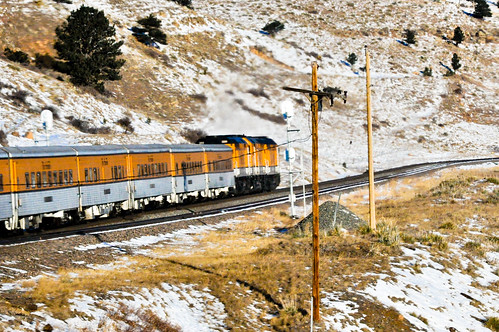
I just recently learned that the Denver to Winter Park Ski Train, that has operated since 1940, was sold last spring and it's long run as a fixture in Colorado came to an end.

But maybe not. Recent news articles (and discussion) indicate that service may be reimplemented with a new owner and partnership with Amtrak this winter.

Although I lived and skied in Colorado, I never took the ski train, although I know people who did.

According to the owner, the ski train never made money and its costs were escalating, making it even more unprofitable. It cost too much to run the train. Clearly, there is something wrong with this. It can't possibly cost more to carry several hundred people from Denver to Winter Park on a single--albeit large--vehicle than it would cost to have them all pile into individual cars and drive themselves in groups of twos and threes. And so it is true.

The problem is that the train is expected to support itself and its infrastructure while I-70 is paid for by everyone through their taxes. There isn't even a toll; it's a free road. Other costs of driving are lost as externalities--most glaringly the traffic delays that have become legion on weekends. When I was growing up, we could drive from Colorado Springs to Winter Park in about 2 1/2 hours. Now it takes that long from Denver, which is 50 miles closer.

Some have suggested adding a 3rd lane in each direction on I-70, which would cost more than $4 billion. Others have countered that it would be possible to implement high speed rail to alleviate the traffic for less than that. If I were betting, I'd probably bet on the highway, even though there are almost certainly several other solutions that would cost less. That's because until we can change the institutional and societal expectations that roads are "free" and other transportation is "subsidized," we'll keep building the roads, even if they are the least efficient solution.

So let's bring the ski train back, and let's subsidize it just enough to fill it to capacity every trip. And then let's add a second train 45 minutes later and fill it up, too. And then another. And we can have the drivers, whose trips are now made faster and easier, because there are several hundred fewer cars, help pay for the trains. That seems fair to me: we reduce traffic, pollution and stress for all, and everyone shares the costs and benefits.
================
(train photo by Zach Graves; I-70 traffic photo by Sarah McGee)