Showing posts with label bicycling. Show all posts

WaPo letter writer is all wrong

On November 14, the Washington Post published this letter to the editor from Hays Browning of Washington, DC
With more bicyclists on the District’s streets, the D.C. Council should review the rules governing their behavior. The prohibition of bicycles on sidewalks should be extended from the downtown core to busy areas such as Georgetown, Dupont Circle, Cleveland Park and Glover Park. Sidewalks are supposed to be safe for pedestrians, but bicyclists are acting as if they have the right of way.
The Metropolitan Police Department should enforce the law against bikes running red lights and stop signs. If bicyclists obeyed basic rules, they might find less aggressive driving by motorists. Bicyclists also should not ride in the wrong direction on one-way streets unless there is a designated bike lane. Bicyclists should make sure drivers can see them, especially after dark. In any collision with a motor vehicle, right or wrong, the bicyclist is most likely to come out second-best.
Maybe Capital Bikeshare could remind its customers of proper bicycle behavior and courtesy. If that behavior doesn’t improve, perhaps we will head in the direction of countries where bicyclists are required to be licensed.
Hays Browning, Washington
It's disappointing that the Post would publish this.  Although it is the opinion of a letter writer, it perpetuates misconceptions and does little if anything to advance the needs of anyone: driver, cyclist or pedestrian.

First, why are cyclists on the sidewalk in the first place?  Because they like scaring little old ladies walking there?  No.  They ride on the sidewalk, because they do not feel safe and comfortable riding in the street.  If Mr. Browning would like the cyclists to get off the sidewalk, he should advocate for better bicycle facilities.  Cyclists rarely if ever bike on the sidewalk along 15th St. NW, because they have a safe, comfortable place to ride designed for them - the 15th St. cycletrack.

Likewise, cyclists will not ride on the sidewalks in these other locations either, if provided with safe and comfortable options.

If bicyclists obeyed basic rules, they might find less aggressive driving by motorists.

Who is Mr. Browning referring to?  Does he have insight into anyone else's driving behavior besides his own?  How can he make this assertion?  I might ask him if he would somehow alter his driving habits if he perceived all the cyclists behaving the way he would like.  Does he currently drive aggressively around cyclists on purpose?  If not, then who does he claim does, and how does he know they will change their behavior?  Or is he just making this up?

If that behavior doesn’t improve, perhaps we will head in the direction of countries where bicyclists are required to be licensed. 

Like where?  I just spent 10 minutes on Google and could not find a single example.  If Mr. Browning knows of a place that has bicycle licensing that results in greater safety for all road users, I'd love to hear about it.

Connecting Ballston to Clarendon for cyclists

Arlington County, VA has been improving its bicycling infrastructure along the Rosslyn-Ballston corridor.  With the addition of the buffered bike lanes on Clarendon Blvd. through Clarendon, there is now an almost continuous corridor from Ballston to Courthouse.  There is, however, a two-block gap that is difficult for cyclists to navigate that--if improved--could make a significant difference in the ease of use for cyclists along the corridor.  It would close the one remaining gap connecting these important activity centers.

With some minor infrastructure changes, this gap could be closed, and the corridor could be completed.

Here's a diagram of suggested improvements for eastbound cyclists at the intersection of Fairfax and 10th St. N.

Big increase in bicycles at Swanson Middle School

School is back in session for 2013, and my local Middle School has a big increase in bicycles parked on its racks.  Since I walk and cycle by here regularly, I have made a habit of taking a look at the bike racks.  They are now officially full: 32 bikes parked on September 9 and again on September 13.

As I've mentioned in my previous posts (here and here), I think these are the smartest kids in the school.

Photo from September 9


Photo from September 13

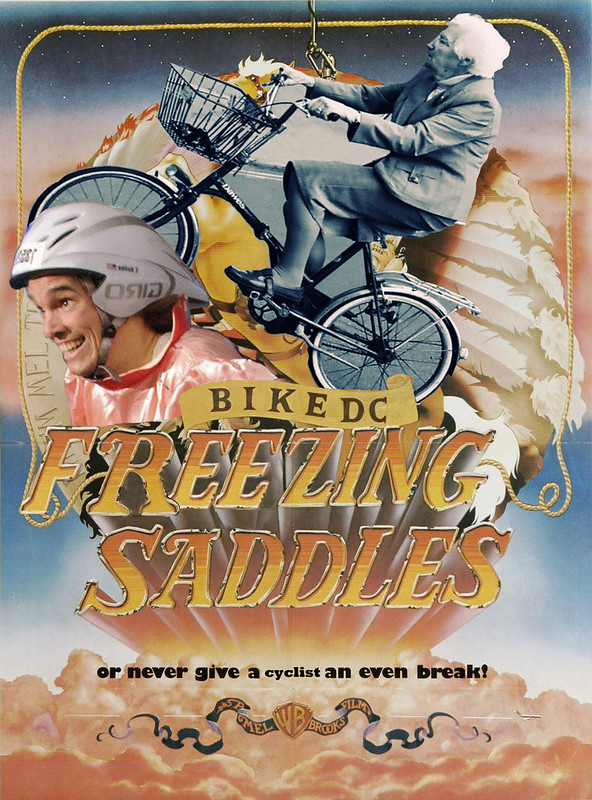
Freezing Saddles Winter Bike Competition

I just joined the "Freezing Saddles" friendly winter bike competition here in Arlington County.  It will be a fun way to track our winter bike rides.  Riders were assigned to teams to make for an even challenge.  I'm on Freezing Saddles Team 9, but the suggestion "Bollard Busters" has been proposed as a better name (particularly given my reputation as being anti-bollard).

All this is being tracked in Strava.  Here's the link to the ongoing results page.  Finally I'll be able to put my Garmin device to good use.

I regularly cycle 2-3 times a week to Kensington, MD (about 13 miles each way) for some work I do.  I also cycle around town for errands and such.  So hopefully I will be an asset to our team.

And here's the link to the DC Bike Forum conversation about the challenge.

Should be fun!!

Tree Hugger Meets the Bike Hugger

Arlington County's continuing efforts to improve the network of bike infrastructure has recently butted up against Arlington County's efforts to improve its urban forest.  These represent two environmental goods--both of which I have strong support for.

The County is now in the final stages of engineering the extension of the trail along Washington Blvd. south of Route 50 to Columbia Pike (via Towers Park) (map).  The construction of this trail will require the removal of about 350 trees, some temporarily and some permanently.

As a member of the Arlington Bicycle Advisory Committee, I advocate for and support the County's efforts to continually improve bicycling for our residents and visitors.  This trail extension is an important part of the cycling network.

As a long-time environmentalist working on climate change and an amateur urban planner, I fully understand the tremendous value that trees and tree canopy bring to urban areas like Arlington.

So what's the tree hugger to do when he's also the bike hugger?  It's a tough question, worth asking.  I believe asking the question allows us to think about an approach that can lead to a reasonable solution.

Some of these trees will be removed in order to construct the Washington Blvd. trail extension
First, my tree-hugger self has to agree that there is value in the trail extension.  My bike-hugger self must acknowledge that those trees are also important.  Likewise with the communities involved.  Those who paint one side or the other as wrong while they are "right," ultimately work against any kind of solution.  And if they "lose," then they may likely get nothing that they want.

Once both sides of me acknowledges the importance of the values of the other side, then we can work together to find a solution.  The solution may not be perfect for one or both sides, but mutual respect and a collaborative approach is much more likely to create a result that can benefit both.

I don't know what the absolute perfect solution would be, but I do believe that the trail extension is a critical link, so some way of building it must be found.  Perhaps the construction of the trail could provide an opportunity to actually enhance the urban tree canopy?  Currently, this area is partially wooded and completely unmanaged: some of the trees are full-grown native trees, others are overgrown bushes and others are invasives.  Kudzu has invaded, too, threatening many of the trees that are there already.

Because of the topography, some trees will need to be removed, but can be replaced once retaining walls are built and the trail is completed.  The entire project may present a terrific opportunity to create an even more beautiful canopy as well as improve habitat.  By working with arborists and urban forestry experts, perhaps an even better canopy could be created in harmony with the trail.  I don't know if this is possible, but I am sure that some aspects could definitely be improved.

For instance, I recently planted an elm tree in my yard in a small effort to help re-establish elms in America.  Imagine if this project included planting numerous elms alongside Washington Blvd.  Once grown, they could create a beautiful tree-lined boulevard, shading both the trail and the street, with all the concomitant environmental benefits.  It probably won't look quite like this, but still could be a big improvement.

The first step, though, is to get past the idea that these two environmental efforts should be battling each other.  My bike hugging self is not the enemy of my tree hugging self.  We both want a better Arlington community to live in.  The challenge is to find a way to turn this project into an opportunity.


My public comments to Arlington County Board re: Bollards

On May 19, I attended the Arlington County Board meeting and made comments during the public comment period.  Each commenter is allotted two minutes, so I had to keep my remarks short.

(For more details and photos, see my recent post on this issue)

Here is the text of what I said:

My name is Steve Offutt, and I wanted to bring to the board’s attention recent activity by the parks department that needs to be addressed as soon as possible.

More bollards in Arlington County

There has been a proliferation of bollards in Arlington County over the last few weeks.  I know of six that have been installed within one mile of my house, all of which are unnecessary.

From conversations with insiders, I have learned that these bollards are being installed without consensus among staff and against the recommendations of some staff with cycling expertise.  In any case, they are being installed without community input and without any input from the Arlington Bicycle Advisory Committee, of which I am a member.  I have previously posted about how bollards are mostly unnecessary and often create more problems than they solve.

(UPDATE: I made comments to the Arlington County Board on May 19.  Text of my remarks is here.)

The new East Falls Church bridge went into service last month, and about a week later four bollards were installed: three at one end and one at the other.  These three went in first:

Arlington County begins posting new trail "wayfinding" signs

Arlington County has started installing the first of the 250 "wayfinding" signs it has planned for along the Rosslyn-Ballston corridor (as detailed here).  I have blogged on trail signs in the past--mostly negative, because they either tend to not exist or fail to function well.

So it's great that these are finally going up.  I'm sure I will have criticisms (see below), but signs of almost any kind are better than the absence of signs.  So all in all, this is a great step forward.

 I took pictures of them and their exact locations are shown on this map:
This one is mounted on the sound wall at the entrance of the trail  It is excellent that the signs indicate the name of the trail.  In the past, this has often been a problem.  Signs would point towards destinations but would fail to tell you where you were.  Now someone using Google Maps and given the direction "Turn Right on the Custis Trail" will have confidence they are in the right place when they reach the trail.
The East Falls Church distance indicator is swapped with the one on the sign below.  This sign is actually closer to East Falls Church than the sign below, but indicates that it is farther away.
--------------------------------------------

Five years of blogging on Transform to Sustainability

Without realizing it, the 5-year anniversary of my original blog passed by last month.  Since then I have posted 368 posts here.  Many of these have also been featured on other blogs, including:
So what has been popular?  Below is the list of my all time top ten blogs by number of views:

Arlington looking for help with bollard locations

Arlington County has created a public Google Map that people can edit with bollard locations and issues.

View Arlington Bollards in a larger map

In particular, they are asking for locations where bollard collars (that part in the ground that holds the bollard itself) may be sticking up causing a hazard. Since we have the map, it will also be useful for identifying other bollard-related locations, such as where bollards are needed or where they should be removed.

I have posted on this topic before (here and here). Those who know me know that I am opposed to bollards in general and believe they should only be installed where there is documented need, rather than at every intersection just as a policy. The W&OD trail removed all its bollards along the entire 45 miles some years back and experiences few problems with cars. Not zero, though. However, they have decided that the positive aspects of better aesthetics and safer travel for cyclists outweigh the negatives of a rare car encroaching on the trail.

Please check the map out and add any locations that you believe could use attention. It's easy, just click on the EDIT button and you will be able to edit the map. Remember to save when you are done. Thanks for your help.

On-street Crescent Trail will be worse for bikes and peds

(This is an unedited cross post from Greater Greater Washington)

This post is in response to a Greater Greater Washington post from Dan Reed: On-street Crescent Trail may be better for bikes and peds

I disagree with almost everything Mr. Reed suggests in his post.

For a year or so I commuted through that tunnel almost every day. It is an excellent amenity.

Mr. Reed suggests that the on-street alternative may be safer because of the likelihood of crime, and he points out crime problems at other bike/ped facilities.  This is a red herring argument.  The tunnel has been open since 1998 and crime has not been an issue.  Undoubtedly it will be even less so with greater usage.  The safety benefit of not having to cross Wisconsin Avenue at grade is much greater than any potential danger associated with crime.

New bridge design serves pedestrians and cyclists better


Arlington County has chosen a design (pdf) for its upcoming rehabilitation of the Carlin Springs bridge over George Mason Drive.

The current bridge has five-foot sidewalks and no accommodation for cyclists.  The new bridge will have 8-foot sidewalks and 5-foot bike lanes on both sides.  The rest of Carlin Springs Drive does not currently have bike lanes, but it is important to plan for the future by including them now. Had the County not included better bike/ped accommodations, then those decisions would have been difficult to change for 30 or more years.

Kids keep getting smarter. More and more bicycling to school.

Twice in the past (here and here) I reported on the bikes that were parked in the racks at Swanson Middle School in Arlington.  Two years ago there were thirteen.  Last year there were eighteen, and they had expanded the racks.  This year on bike-to-school day there were twenty-one, and as you can see in the photos below, they are just about out of room in the bike racks again.  One rider's bike is parked on a nearby tree.
It's great to see more and more school kids riding bikes to school (and some staff, too).  There are about 800 students and staff at Swanson, so these bikes represent 2-3% of the total population.
Swanson bikes 2011 btsd
Bike racks are full on bike to school day 2011

Swanson bikes 2011 btsd 2
One cyclist's bike is parked on the tree due to full racks
\

Solving the Lynn Street/Lee Highway Bike/Car Conflict

The intersection of Lee Highway and Lynn Street in Rosslyn, where the Custis Trail crosses Lynn St., has been the subject of great scrutiny lately. (GGW reported on a recent meeting at this very intersection.)  This is one of the most dangerous intersections for cyclists in the Greater Washington area. By reconfiguring the exit ramp for the Key Bridge, this conflict can be entirely removed, dramatically improving safety while also potentially improving traffic flow.  (This post has been cross-posted at Greater Greater Washington, including a number of reader comments.)

The problem at this intersection is traffic turning right from the I-66 off-ramp onto Lynn Street traveling towards the Key Bridge.  This traffic has a green light at the same time as the pedestrians and cyclists have the cross signal. There are two lanes of right turning cars (and sometimes cars in the third lane turn right illegally). By shifting the Key Bridge traffic to the north of the Custis Trail crossing, this conflict will be eliminated.

Bike commuting in DC highest in US Northeast - among highest in nation

According to a recent article in the The Atlantic Cities, bike commuting has seen significant increases across the US between 2000 and 2009.  In the Northeast region, DC led the pack, tied with Philadelphia, at 2.2%.  That is up from 1.2% in 2000.Bike commuting table
Although DC's increase in cycling was not as remarkable as some of the other Northeastern cities, DC started the decade with more bike commuters.

Capital Bikeshare featured on Streetfilms

The amazing success of Capital Bikeshare is being noted not just here in the DC area (such as in the Wash Post), but nationwide and around the world.  The acclaimed Streetfilms featured Capital Bikeshare last month.

Arlington County installs new bike signal on Custis trail

Arlington County has installed a bike-only signal in the Rosslyn area of the Custis Trail at the corner of N. Oak Street and Lee Highway, which went into service on Tuesday, May 17.  This is one of the intersections on the "Rosslyn Hill" section of the Custis that includes several crossings.  There have been collisions at some of these crossings in the past.  This area is definitely the most dangerous section of the Custis Trail.


View Custis Trail bike signal location in a larger map


The perfect bike trail bollard installation

For those of you have read my previous post on this topic, you will know that I am not a fan of bollards on bike trails.  Hence this photo of what I consider to be the perfect bollard installation.

Bicycle Facility Film Screening ar Arlington Central Library Brings Biking Community Together

More than 100 people attended the film screening held on Monday evening at the Arlington Central Library.  This film screening was hosted by the Arlington Bicycle Advisory Committee, with additional assistance (including sponsoring the food) from BikeArlington.
_MG_6950
Although many attendees were from Arlington, there were also representatives from Fairfax County, Falls Church, Alexandria, DC, Montgomery County and even one from Kentucky who was in town to attend the National Bike Summit.

Mark Blacknell, Chair of the Advisory Committee, made some remarks and introduced and thanked a number of people, including Arlington County staff who work on bicycling related matters and the staff of BikeArlington, who work to spread the word about biking throughout the community. Image001
The film, a documentation of bicycle practices compiled by James MacKay during a 2009 European tour, was relatively technical in nature. However, it catalyzed an animated discussion afterward among attendees.  As a member of the Bicycle Advisory Committee, I was excited to see so many people with ideas and opinions about how to improve bicycling in our community and the region.

Afterward, approximately 20 attendees retired to a nearby bar/restaurant to carry the discussion further.
The Arlington Bicycle Advisory Committee is open to the public, and all are invited to attend.  Meetings are held the first Monday of the month at 2100 Clarendon Boulevard in the ground-floor conference rooms.  We hope to see you there. 

If you are interested in keeping up with news about bicycling in Arlington and would like to be notified about future events, please visit the BikeArlington Forum or send an email to BikeArlington.

Film Screening, Discussion and Advisory Committee Meeting on Monday, March 7 in Arlington

DSC00815[1] Wouldn't it be great to have the kind of bike facilities that can be found in many parts of Europe right here in the DC area?  Local jurisdictions like DC and Arlington are improving their facilities all the time, but there's still a long way to go.

Next Monday, March 7, the Arlington County Bicycle Advisory Committee will be hosting a film screening of the 2009 SCAN tour of Europe that was sponsored by AASHTO (the American Association of Highway and Transportation Officials), FHWA (Federal Highway Administration) and NCHRP (the National Cooperative Highway Research Program).

You are invited!  Please come, see the 45-minute film and participate in a follow up discussion afterward.  Here are the details:

Date:  Monday, March 7, 2011
Time: 6:30 PM - gathering & snacks; 7:00 PM - film screening; 8:00 PM - discussion
Location: Arlington Central Library - 1015 N. Quincy Street (map)

Who should comeEveryone! Especially bicyclists, pedestrians, bicyclist wannabes, planners and those interested in transportation and urban design.  Feel free to RSVP at our Facebook event page; it will help us plan, but it's not necessary in order to attend.

Everyone is also invited to join the Arlington Bicycle Advisory Committee afterward, about 9:00, at Carpool for our regular monthly meeting.  Arlington BAC meetings are open to anyone, and all are welcome.