Monday What's on the Web: Greater Greater Washington

Every Monday I highlight other bloggers or web contributors who are making important or interesting contributions to climate, sustainability, transportation or market transformation. Check back each week for another installment.
----------------------------
Greater Greater Washington is a regional blog focused on the Washington DC area. In just a couple of years it has grown to become a highly respected and widely read resource for people interested in issues that affect the current and future Washington DC metro area. Many days it garners over 20,000 page views.

Issues run the gamut, but often focus on transportation and development as drivers for the future. The blog takes a very new urbanist angle on these issues--tending to suggest ideas like complete streets, increased and improved transit, increased costs for driving and parking, better bike facilities, mixed-use and transit-oriented development, etc. It reflects the goals of this blog in that it is working towards positive transformation that will improve our environment and quality of life.

David Alpert runs the blog and has actually become a known person to some in the local media (some like him; some don't). It is clear that some staff at Metro and local jurisdictions read the blog and may actually be taking ideas from it. There are several dozen contributors, and the blog runs several posts a day--so the content is always changing as well as substantial. I am one of those contributors, and you may see my posts here.

Security Barriers: A Little More Thought

The concrete planters around the Hirshhorn Museum helped slow a wayward truck that crashed into the museum Monday night. This incident was not a deliberate attempt to attack the building; it was a totally freak incident which had never happened before. Although this will probably spur efforts to increase the security measures around the building, it really should be a catalyst for rethinking the purpose and even the need for these ugly and ineffective barriers entirely. Not just here, but in most locations in DC.

Post 9/11, jersey barriers, concrete planters, bollards and other "security" measures sprung up like weeds everywhere in Washington, DC. First they were located around places like the White House and Capitol, but before long they started surrounding virtually every building that housed a federal worker or was owned by some level of government. By now, the totality of those barriers must cover scores of acres of valuable sidewalk real estate. They create an unwelcome atmosphere to pedestrians, forcing them to weave and sometimes wait for others to make room just to walk to and from their destinations. Most of them are unsightly at best and downright ugly at worst. The open space and welcomeness of virtually every outdoor space in the core of DC has been degraded.

It's understandable that we put measures in place to protect the White House, Capitol and other key potential targets. But, HELLO!, the Hirshhorn is not a target. It is not on any terrorist's list of buildings. Shoot, most people have never even heard of it. When out-of-towners come visit, and I recommend it to them, never once has anyone heard of it before. I even know people who live here in DC who haven't heard of it. It's not on the list. Neither is the Renwick, the Phillips Collection, the Freer Gallery, etc.

The Guggenheim Museum in New York City is much more iconic than the Hirshhorn. A quick check of street view in Google shows no barriers protecting the museum entrance from the street. Pedestrians may walk easily and directly into the building without any impedance from barriers of some sort. Likewise with the Philadelphia Museum of Art, the Chicago Art Institute, The Metropolitan Museum of Art, and, for that matter, the most famous art museum in the world--the Louvre in Paris. What are we afraid of that they are not?

Washington DC is the capital of the United States, supposedly the beacon of freedom in the world. Yet in our capital, the simple freedom of being able to walk on sidewalks and enter public buildings unaccosted has been taken away. Each little step in this direction chips away at the free society that supposedly reflect our nation's fundamental values (see recent post re: overhyped security on Earth Day).

Linda St. Thomas, a Smithsonian spokesperson said that the planters did what they were supposed to do. What?!? What exactly is it they are supposed to do? Were they supposed to "slow" an out-of-control truck so that it still struck the building, causing damage, but maybe not as much? Was that their intent when they put them in? That's laughable. No, they were put there to protect the building from intentional attack; it's just coincidental that they happened to slow the truck down a bit--not the intention of the barriers at all. In fact, now it's obvious that these barriers all around town are just a charade, because they wouldn't stop a determined terrorist anyway--they can just be pushed aside by a medium-sized truck. The point, though, is not that we need to bolt them down or make them heavier. It's that they don't really need to be there at all, because they are an illusion--protecting against an imaginary threat.

Here's a thought experiment. Imagine the truck had its accident a mile or two away in a commercial corridor--running into a storefront. Would the reaction be to suddenly install some sort of barriers along the street to protect against the rare wayward vehicle? Would we put up bollards or barriers along every street? No. The owner would file a claim with its insurance company, fix up the store, and life would go on as before, with the sidewalks adjoining the street as always.

The Hirshhorn is an art and sculpture museum. It celebrates the aesthetic of the visual. The building itself--love it or hate it--is a piece of visual art. It is surrounded by sculptures. If anyone should understand the negative visual impact of these ridiculous planters (even worse are the jersey barriers on the Jefferson Dr. side of the museum), it should be the curators at this museum.

Ms. St. Thomas also said (as reported in the Washington Post), "Maybe one piece of good that could come out of this is a little more funding and little more thought into where we really do need security and how we do that correctly and appropriately,"

Yes, a little more thought, thank you. And perhaps a little less funding. Like let's get rid of them entirely in about 90% of their locations around DC. They are unnecessary; evidently they don't even function to protect the buildings as intended; they rob us all of valuable space; they are ugly, visual clutter; they run counter to our nation's values; and they degrade the experience of citizens of and visitors to our nation's capital.


(Louvre photo attribution: http://www.flickr.com/photos/juanillooo/ / CC BY-NC-ND 2.0)

Market-based permeable surface

Last year I presented an idea I had for increasing tree canopy in urban areas on this blog and for the 2009 Policy Greenhouse held at George Washington University. You can read my complete blog post here.

Another factor in the environmental performance of urban areas is the amount of impermeable surface that exists. More impermeable surface creates more and faster runoff, increases pollution in waterways, can cause localized flooding and can also contribute to the urban heat-island effect. Reducing the amount of impermeable surface can be achieved using a similar cap-and-trade approach as I recommended in the tree canopy post.

The idea is straightforward:
- Require all landowners to reduce their impermeable surface to below a certain percentage--say 30%
- Landowners who reduce their impermeable space below the limit earn credits for each square foot of area that is additionally permeable
- Landowners who do not reduce the required amount may purchase credits from those who have them in order to meet the requirement.

Example:
1) A homeowner on a 6000 square foot lot needs to have less than 1800 square feet of impermeable surface to meet the requirements. She takes out her driveway and reduces her impermeable surface to 1000 square feet, giving her 800 square feet of credits. (There are lots of ways to reduce impermeable surface.)
2) A parking lot property of 10,000 square feet has 9000 square feet of impermeable surface--6,000 square feet above the requirement. This parking lot owner buys the credits from the homeowner and other homeowners who have credits to sell until he meets the requirement.

The beauty of a system like this is that the government sets the goal, but the market delivers the results. Simple supply and demand will control the price, and people will respond by increasing their impermeable space when the price is high enough to make it worth their while to do so.

Monday What's on the Web: DeSmog Blog

Every Monday I highlight other bloggers or web contributors who are making important or interesting contributions to climate, sustainability, transportation or market transformation. Check back each week for another installment.
----------------------------
This week's featured web resource is the blog DeSmogBlog. This blog was started in 2006 specifically to attack and debunk misleading and false claims from global warming skeptics, delayers and deniers. As they state on their site: "DeSmogBlog exists to clear the PR pollution that is clouding the science on climate change."

There are a lot of blogs out there--including mine right here--that address a broad spectrum of environmental and climate issues. What I like about DeSmogBlog is that it focuses on the specific topic of countering the claims from the skeptics. Because this is their focus, they do an excellent job of it. Recent posts include:

- Conservative Talk Show Host Brian Sussman Adds 'Climategate' to His List of Favorite Conspiracy Theories

- Unnamed Physicist Sponsors Global Warming Denial Video Targeting High Schoolers

- Tim (C-A-B-A-L) Ball: Climate Science is All a Conspiracy!

In addition, James Hoggan, a cofounder of the site, authored the 2009 book Climate Cover Up: The Crusade to Deny Global Warming, which documents the deliberate and devious efforts of the oil and gas industries, along with others, to create doubt and delay efforts to address climate change.

You can also follow DeSmogBlog on Twitter @desmogblog


Climate Decade in Review - Post 35: Bush Administration Links Emissions With Atmospheric Buildup (Later Recants)

On May 28, 2002, the State Department issued its Third US Climate Action Report (mostly written by EPA), as required by the UNFCCC. The report clearly linked the buildup of greenhouse gases in the atmosphere with human emissions, documented potential impacts and--all in all--gave a relatively balanced assessment of the current understanding of climate change. This despite the fact that Phillip Cooney, who had recently joined Bush's Council on Environmental Quality (CEQ), did his best to water down the language. His effort failed, and the New York Times published a story about the report.

Cooney turned to the right-wing Competitive Enterprise Institute for help to undo the damage he had done. The head of CEI, Myron Ebell, replied, "I want to help you cool things down, but after consulting with the team, I think that what we can do is limited until there is an official statement from the administration repudiating the report."

Voila! On June 4, President Bush made his famous remark that the report was "put out by the bureaucracy."

(For lots more on this and other aspects of the Bush effort to delay action on global warming, click here.)

=================
This is one in the series of "Decade in Review" posts on this blog that began in January 2010. These posts present climate-change-related events that occurred during the 00's, the warmest decade in recorded history.

Monday What's on the Web: WonderingMind42

Every Monday I highlight other bloggers or web contributors who are making important or interesting contributions to climate, sustainability, transportation or market transformation. Check back each week for another installment.
----------------------------
This week I highlight Greg Craven and his video blog, which he publishes under the YouTube name WonderingMind42. Greg Craven created the video, "The Most Terrifying Video You'll Ever See," and the follow-on (and better) video, "How it All Ends." Greg's most important contribution to the climate change argument was to ask a totally different question than the usual argument about whether or not climate change is real and if humans are causing it. Instead, he asks the question, "What do we do, given the uncertainty?" If you have never seen his videos before, I highly recommend them. Here is the "How it All Ends" video. Click on the title above for the other one.


Google Bike Directions: Part 2

Yesterday I blogged the story of using Google biking directions to travel from my house in Arlington VA to a friend's house in Springfield VA using Google bicycling directions to help me navigate.Cycling-mountain-biker

My second trip was to travel from this same friend's house in Springfield to the Whole Foods in Vienna. Unlike the first trip above, in which I was familiar with the first part of the route (and could adjust based on my knowledge), in this case I was completely dependent on the Google directions. I had never ridden in this area before.

In this case, the directions proved to be excellent, with one exception. The implementation of the directions presented some problems, but the actual route worked almost perfectly--taking me along mostly back streets and some trail connectors right to my destination. The major obstacles in this case were Route 50 and I-66. The crossing at Route 50 actually turned out to be better than expected, because there was a trail connector that Google Maps was unaware of that I noticed when I reached the intersection of Pickett Road and Arlington Blvd. I-66 was crossed on Vaden Drive, a back street that crosses the Interstate with no interchange.

The biggest problem presented by Google biking directions is that trail signage is typically so poor--or not designed the way street signage is--that it presents challenges for giving and following directions. At every single intersection of two streets, there is a street sign. It was simple to follow the directions: Turn right at XXYZ St. or left at ABBC St. At each of these points, I was virtually 100% confident that I was following the directions as indicated. However, each time I had to travel on a trail, I lost confidence, because the trails did not have signs like the streets. On this trip, even the trails with signs had different names than what Google indicated them as. The most disconcerting part was when I was traveling along a trail and would encounter an intersection or fork in the trail. Google does its best, but without any signage, it just states "Turn left toward Vaden Dr." or the like. If the cyclists doesn't know where the named street is, then there is no way of knowing what those directions mean. Thankfully it was a sunny day, so I could at least tell what direction I was going and could correlate that with the line on my map.

Google biking directions is a good tool for cyclists. If jurisdictions would now please put up signage that will help cyclists navigate those directions, it would make the tool work much better.

Google Bike Directions: Part 1

LastGoogle Biking  directions  screen shot week I had a couple of opportunities to try out Google's bicycling directions to travel to places I had never gone before. My experience with the directions was mostly positive, guiding me along routes that for the most part worked well. The problem of poor trail signage (not Google's fault), however, could have caused a cyclist to become temporarily lost. Here's the story.

I wanted to travel to a friend's house who lives just off Braddock Road in Springfield VA about one mile west of the Capitol Beltway (I-495). I live in Arlington VA not far from Seven Corners, about 8 miles away. I had never been to my friend's house before, so I asked Google to give me cycling directions there. What I look for in the directions is how it overcomes the major obstacles, in this case, Route 50 and the Beltway were two major roads I had to cross. Google did not have me cross Route 50 at the new pedestrian overpass at Seven Corners, which I think is a better option than what it showed me. It did, however, have me cross the beltway at the pedestrian overpass that is north of Braddock Road about 1/2 mile, which is definitely the best option. All in all, the directions were not bad. A less experienced cyclist might have found some of the roads--particularly Braddock Road--a bit daunting to ride on. However, the directions worked for getting me there.

All in all, Google biking directions is a useful tool, and I expect it will become more useful over time as Google--and users--improve it.

Monday's What's on the Web: Climate Progress

Starting today, every Monday I will highlight other bloggers or web contributors who are making important or interesting contributions to climate, sustainability, transportation or market transformation. Check back each week for another installment.

This week I highlight the blog Climate Progress and its prolific blogger, Joe Romm. Launched in August of 2006 and supported by the Center for American Progress (where Joe is a Senior Fellow) Climate Progress is an indispensable blog for anyone interested in the "debate," politics, science, media coverage and virtually every other aspect related to the issue of climate change. Climate Progress is very up to date, covering breaking scientific studies, media coverage, news, political actions etc., generally within a day or less.

Joe brings a strong point of view to the issue--a point of view that I share. That is, climate change is the most serious issue mankind is facing, and strong and immediate action must be taken. Joe takes pleasure in debunking and beating up on deniers and delayers. His knowledge of the science is deep and broad. He is the main contributor to the blog, although he also includes guest bloggers. Posts tend to be fairly long and in depth, sometimes including significant detail and always containing significant opinion.

Example titles include:
- Lugar and Voinovich float “half-assed” alternative to comprehensive climate and clean energy jobs bill.
- Must re-read statement from UK’s Royal Society and Met Office on the connection between global warming and extreme weather
- WashPost editorial: “If current trends persist, it’s likely that in coming decades the globe’s climate will change with potentially devastating effects for billions of people.”
- Report: Koch Industries outspends Exxon Mobil on climate and clean energy disinformation

Also, be sure to take in the comments. There are a number of commenters on this blog who add considerable insight and depth to some of the posts.

Flying Into the Volcano Dust

It's been front page news for a week, the Icelandic volcano sending up clouds of volcano ash, shutting down air traffic across Europe for more than a week and still disrupting it as this is being written. Our current course on addressing climate change (i.e., inaction) is the same as if air travel had just continued on as usual through the volcanic ash. When planes started falling out of the sky or landing with damaged engines, we could then get a good sense of the risk.

We did not continue business as usual with air travel in Europe when faced with a real but uncertain risk. In contrast, we barrel along--business as usual--changing our climate knowing that there are huge risks involved. Risks, in fact, far larger than those posed by the volcano and air travel thus far.

If the risk were only 1:1000 that a flight would crash due to volcanic ash, that would result in about two dozen crashes per day. We know the risk of catastrophic climate change is orders of magnitude greater than that, yet we continue to do very little to curtail our emission of greenhouse gases.

What is wrong with us?

Obama's Earth Day Message and Challenge

The White House released this video advocating that citizens across the country do their part to help in addressing our environmental problems.


Although President Obama claims that our environment is cleaner than it was 40 years ago on the original Earth Day, that is true only if you look at it from certain perspectives. Certainly if we include the entire earth (not just the United States), that would be absolutely untrue.

Check my Twitter feed for some of the changes that have occurred since that first Earth Day. Some are better, some are worse. Most critically, when it comes to the largest environmental issue of all--climate change--we have made no progress and are continuing down a very dangerous and potentially disastrous path. (Also see my Climate Decade in Review posts for more on what has and has not happened in the last ten years).

That said, I stand alongside President Obama in urging people to take action on Earth Day and every day.

Incorporating Green Residential Building into Residential Areas

As architecture and construction become more and more green, residential buildings that significantly reduce energy use and incorporate other environmentally friendly features will hopefully become more common in our urban areas. One builder in Arlington has created an innovative and effective green home in a residential neighborhood in the Westover neighborhood.

Builder Patty Shields of Metro Green Home built the home depicted in the drawing here. It is the first home in Virginia to receive a LEED Platinum certification from the US Green Building Council (USGBC).

This home was built on an odd-shaped lot that had not previously been built on. Due to its unusual triangular shape and small size, it required zoning waivers for setbacks and other requirements. As part of the overall project, Ms. Shields renovated the farmhouse next door, also incorporating significant green practices in order to gain approval from the county to develop this lot.

This house incorporates a modern architectural palette, which is in contrast with the ubiquitous colonials surrounding it. Roger Lewis of the Washington Post recently wrote an article discussing modern architecture for residential construction, which is generally shied away from for a number of reasons he mentions--particularly risk aversion to change. In this case, I believe the builder has been sensitive to the community, created a more modern home while pushing the envelope a little toward integrating more modern ideas into traditional neighborhoods.

More significantly, she took a holistic approach towards the sustainability aspects of the house, incorporating better design, materials, systems and components in from the very beginning (for details and lots of photos, see her web site). The home is also located in a walkable neighborhood one block from a bus line that serves Metrorail and about a 20-minute walk to the East Falls Church metro stop. The earlier in the process sustainability is brought in, the more effective and less expensive it is to incorporate. Intelligently designed green construction can cost very little extra or sometimes no more than traditional building, and energy cost savings virtually always swamp any additional costs. Getting local governments to put more muscle into residential construction programs could be a very effective way to make environmental progress.

Arlington has developed a Green Home Choice program to try to encourage builders to incorporate more sustainable practices in their new homes. However, it offers very little incentive: the only real one (and minor at that) is front-of-the-line plan review. Everything else is just informational or promotional. Commercial buildings, on the other hand, can receive significant density increases by meeting LEED certification levels. That said, Arlington's web site claims that they are reviewing the Green Home Choice program.

Montgomery County has taken a different tack. In 2008 they passed legislation that would require all new homes built in the County, starting this year, to meet ENERGY STAR requirements. However, the County Energy Code has not been updated to reflect this, nor does the MoCo Department of Environmental Protection mention it on their web site. DC also incorporated new energy codes in January of this year, but has no specific residential construction program. Nor do Fairfax, Loudoun or Prince George's Counties, as far as I can tell. New construction is down due to the current economic conditions. That might make this the best time to develop effective new building programs, so that they are in place and operating when new construction picks back up.

The home featured here at 5803 16th St. N. in Arlington sold last July for $1,175,000

Making Mining Safer With One Simple Change

The news of a tragic coal mine explosion at the Upper Big Branch coal mine in West Virginia has been front-page news for a couple of days. As of the writing of this blog, at least 25 miners were killed with four still missing. Investigations show that the owner of the coal mine, Massey Energy, had thousands of safety violations, including some serious ones related to venting.
(More blog posts: Democracy Now, Open Secrets, Political Animal, and Think Progress)

The company as a whole has paid fines and been cited repeatedly for safety violations. There is, of course, an outcry for stronger regulation. Clearly this mine was operating unsafely. Federal coal mine safety chief Kevin Stricklin said, "We know it wasn't operating safely, or we wouldn't have had an explosion. It's quite evident that something went very wrong here. All explosions are preventable. It's just making sure you have things in place to keep one from occurring."

So we know it was preventable, yet the coal mine company did not prevent it. Why not? I believe it was primarily because it's just not in their financial interest to do so. The monetary impact is much too small. After a 2006 accident at a different mine that claimed two lives, the company was fined only $4.2 million. That's small pickin's for an enormous energy company like Massey. The mine in question, Upper Big Branch has been assessed only $2.2 million in fines since 1995--for more than 3,000 violations! They have only paid $791,327. Massey is contesting $1,128,833 in fines and has delinquent fines of $246,320. (More here)

I would suggest a very simple solution that would almost certainly reduce accidents in coal mines to almost zero immediately: a $100 million dollar fine for every loss of life in a coal mine. No exceptions. No "Acts of God." Every loss of life exacts this fine. Injuries would have smaller, but still significant fines. The only way this policy could work in practice would be to make it without exceptions. As soon as exceptions start to be made, then the whole system gets politicized and eventually it unwinds.

If Massey knew in advance that a major accident could cost them $2.5-$2.9 billion dollars (which is what this accident would cost), they would have done the risk management calculations that showed investing in safety would be well worthwhile. They would pull workers out of dangerous areas when each one is worth a potential $100 million. I suspect coal companies would take out insurance against major losses like this. That's fine. Unquestionably the insurance companies would make absolutely certain that the risks are completely minimized. They would likely do a much better job than the mine safety regulators, because they would have no ties to the industry and would have a very sizable and direct financial investment in risk reduction. They would be all over Massey constantly, making sure their insurance policy would not need to be paid out.

In real life, it seems impossible that such a simple system could be put in place. Instead there will be more and more complicated rules and regulations put into place. In the end, though, unless much, much larger fines are imposed and upheld, the companies will not make anything more than cosmetic or marginal changes. If a company knows that its entire existence may be threatened by a major accident, then it will act accordingly.

Climate Decade in Review - Post 34: Larsen B Ice Shelf Collapse

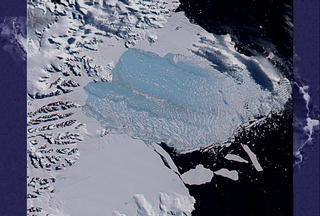
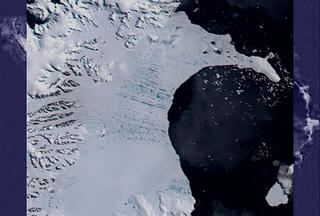
January - March 2002 - The Larsen B Ice Shelf in Antarctica collapsed in the largest ice shelf collapse since satellite imagery began. The collapsed area was 3,250 square kilometers, approximately the size of Rhode Island, and averaged more than 200 meters thick (the thickness of a 50 story building).
Antarctica has been warming by about 0.5 degrees Celsius per decade for the last 60-70 years. This is much faster than the globe as a whole. Both the northern and southern polar regions are warming faster than global temperatures overall, which is consistent withwhat would be expected with climate being driven by greenhouse gas forcings (meaning that additional CO2 and other gases are the major cause of climate change rather than solar output or other causes).

Since the ice shelf was floating, this collapse will have no effect on sea levels (just as an ice cube melting in a glass does not change the water level.) However, as sea ice vanishes, it exposes the darker waters below to sunlight. Ice reflects the sun's rays back into space; sea water mostly absorbs them. This causes what is called an amplifying feedback loop. The more ice that melts, the warmer the sea gets, which causes more ice to melt, etc.--speeding global warming.
Before

=================
This is one in the series of "Decade in Review" posts on this blog that began in January 2010. These posts present climate-change-related events that occurred during the 00's, the warmest decade in recorded history.

Metro Capitalizes on Ubiquity of Buses to Provide Text-Based, Real-Time Traffic Information

Metro launches its new real-time, eyes-on-the-road, traffic texting service today, April 1, 2010. Metro’s recent budget woes have led the agency to pursue both cost-cutting and revenue-enhancing measures. It has also given the agency impetus to look at its strategic assets in new ways. By working with the consulting firm Nozirev, the agency identified its bus fleet as a potential source of new revenues. Metro buses blanket the area, particularly during rush hours, and can provide real-time eyes to traffic situations. (This post is an April Fool's post)

Through a sophisticated texting system, Metrobus operators will respond personally to specific requests for traffic information in their vicinity. This allows commuters to make decisions about what route to take, when to plan their trip, or whether to even bother getting out of bed.

The system is simple to use. Send the text “WMATA” to 96272 (WMATA). You’ll instantly receive the response, “Service requested?” Then reply with “RTRTT” for “Real-Time Regional Traffic Texting.” The response will read, “Are you sure you want RTRTT?” Reply with “Y” or “Yes;” the system will recognize either one and will reply with, “Location requested?”

This is where knowing some shortcuts can really help. You can try texting in something like “Rockville Pike Southbound near White Flint,” which may or may not be clear enough for the system to understand. Instead, by using the 2nd, 3rd and last letter of the street name and ‘N to indicate “and” (as in “Rock ‘N Roll”), you can be assured of a correct identification. Also, for the quadrants of DC, just imagine the map rotated 45 degrees counterclockwise to save a letter. This way, NW becomes W and NE becomes N, etc. Here are some easy examples:

- Georgia Avenue and Military Road, NW is simply coded in as: EOA ‘N ILY W
- Pennsylvania and Branch Avenue SE is easily identified as: ENA ‘N RAH E

Single letter and numbered street names retain their identity, e.g., 23rd Street is 23 and U Street is U.

Reactions to the new system have been almost universally positive. Jake Danvers, who rides the 32 bus on Wisconsin Avenue said, “It works great for me. My driver is telling all those car commuters to go some other way, and that clears the road for us. My ride is a good 2-3 minutes faster now. Also, it’s more exciting. Yesterday, for example, we sideswiped a BMW and knocked over a newsstand. Since our driver didn’t notice, it didn’t cost me any time on my commute. Also, I’ve noticed cars and pedestrians really stay out of the way of the careening bus, so there’s more room for us to barrel down the road.”

Prince William resident and long distance commuter Doris Morris also gushed, “Not only do I get right up-to-date information, the bus drivers’ text notes are often entertaining.” Metrobus has encouraged drivers to inject some personality into their texts as a way of personalizing the service. Metrobus 5A driver Vinny Soros is known for his salty language, with some texts like these:
“No f*&^@in’ way ur gonna b on time! LOL”
“That’s a s*@$tload of taillights up there!”

In contrast, Doreen Phillips, who drives the S2 likes to make biblical references:
“Pslm 37 - Be still in the presence of the Lord”
“Colssns 3:8 But now u must rid yourselves of all such things as these: anger, rage, malice, slander, n filthy language from ur lips.”

A favorite among many commuters is Sokudo Wamatayi, a Japanese American originally from Brooklyn, who occasionally mixes in a relevant haiku:
“Blossoms of pale pink
Universally beckon
Fuhgeddaboudit”

Relevant text information is retained for five minutes, so if another commuter requests information from the same location, they receive the retained text. This safety feature was designed to reduce distractions for drivers. Implementation studies showed that with this system feature, even the drivers with the busiest routes were able to focus on the road more than 70% of the time while still providing extremely accurate information.

Anyone can use the service without registration. Individual texts are $.50 not including costs from your service provider. Daily users, though, can register for unlimited service for only $19.95 per month. Visit www.metroopensdoors.com/OMG.

---------------------
Photo attribution for crushed newsrack: http://www.flickr.com/photos/frankfarm/ / CC BY-NC-ND 2.0