Used Car vs. New Car (Reprise)

A couple of weeks ago I posted my take on the environmental impact of buying new vs. used (see post here). I received a thoughtful email from a reader in Colorado:
-----------------------------
Steve:
I have been thinking about the same question. When buying/trading used cars does MPG matter to the environment?

Most people, rightfully, want to do the right thing for the environment and get more fuel efficient vehicles. But let's go in the opposite direction for the sake of argument.

Let's say that at a used car dealership I hand in my Honda Civic and purchase your Ford Behemoth (and you do the same in the opposite direction) was our transaction environmentally net-net?

I would think so since both cars are in use. Your article seems to point to the same conclusion. Does this abdicate used car buyers from considering fuel efficiency in their purchases and trades?

While I agree wholeheartedly that NEW car purchases need to be as environmentally friendly as possible, to guide manufacturers towards more fuel efficient vehicles. I think that used car purchases are just shuffling owners. The miles in each car need to be 'used up' prior to it's replacement in the U.S./Global fleet with a (hopefully) more fuel efficient model.

I might even go so far as to argue that if you maintain your Ford Guzzler you are doing the environment a favor by keeping it out of the hands of a secondary market. Many of our cars that are highly used end up auctioned and sent to Central and South America, where people may not be able to afford to keep them running as efficiently as possible - or where they would not be subject to stringent emissions monitoring. (A statement of economic inequality, not character.) Where I live near Denver you can watch them parade on Wednesdays from the Used Car Auctions down I-25 headed south towards Juarez, Mexico. Will their new owners have the means to optimally maintain the functioning of the vehicle to ensure minimal environmental impact?

Such thinking would also lead me to believe that a Cash-for-Clunkers would have a long term, net benefit by taking the guzzlers out of the total fleet faster. Obviously, such thinking then also points to the efficacy of raising CAFE standards.

Thanks - I enjoyed your article!

------------------------
And thanks for reading and commenting.
Here's one more twist to think about. I have a colleague who suggests that as long as CAFE standards are in effect and the manufacturer you purchase from is not exceeding CAFE, then by buying a fuel efficient car you are just allowing the manufacturer to sell another less efficient (and more profitable) one, because they can do so and still keep their fleet average above the limit. There's probably a bit of truth to that--CAFE regulates a fleet average, and your purchase is just part of that overall average. However, it's a pretty complicated system (details here), so I'm not confident of my opinion. And all in all, I think the economic signal sent by purchasing a more fuel efficient car is the right signal to send, so I'll stand by my original post.

I'm Top 75!!


I'm pleased to report that I was named as one of the top 75 environmentalists to follow on twitter by Mashable, the Web Social Media Guide. See the list here.

If you like, you can follow me on twitter here.

Rethinking Trail Signage

Not long ago my sister from Los Angeles was visiting me in Arlington VA, and wanted walking directions to a coffee shop. She didn't mind taking a longer walk, so I recommended one about 2.5 miles away that she would enjoy. The shortest and most pleasant way to walk there included sections of bike trails. I found that giving her directions to be really difficult. Everything had to be described in great detail ("After about 600 yards you'll pass under a street overpass. Then I think the next trail off to your right is the one you want. I'm not sure there's a sign, but look to your left and you'll see a marshy area.") Eventually I printed out an Internet map for her to take with her.

Anytime I have tried to give people directions to my house via the trail (which is the easiest way to get to my house from the Metro), I find it challenging to describe where they exit the trail to get to my street. Once on the streets, though, it's easy, because there are street signs at every corner. Once, in fact, I gave my wife directions to a friend's house. Once on the trail, though, one of my descriptions was not quite accurate and she got nervous she was going the wrong way. So she bailed out and walked on the streets, which added about a 1/2 mile to her walk but gave her confidence she knew she was in the right place.

Buying a New Car is More Environmental than Buying a Used One

From Hugo90 on Flickr
About a year ago I was at a conference where the keynote speaker dispensed the conventional wisdom that buying a used car is more environmental than buying a new, say, hybrid. Seems to make sense, and you can find agreement from others: Wired, Knol, Scientific American, BrakeandFrontEnd Blog.

Seems like a no-brainer, right? Manufacturing a new car requires enormous mining, manufacturing, transportation and other costs and energy inputs, while a used car doesn't need to be manufactured; it already is. Case closed.

Or is it? The more I thought about it, the more I realized that the answer really lies in the frame you put around it. If you are worried only about your own personal environmental footprint, then I think the used car is likely better. But if you are concerned about the entire planet (which if you are asking environmental questions like this, you presumably are), then a larger circle has to be drawn than just around yourself, and that changes the answer.

When one goes to purchase their replacement vehicle, what happens to the one they already have? In most cases it is sold to someone else, who eventually sells it to someone else until it finally completely dies after about 17 years and several owners. In fact, every car that is manufactured will be on the road until it finally is totaled or gives up the ghost. Your particular ownership of that car is just a way station on the path from manufacturer to junkyard.

What we environmentalists want to see is manufacturers churning out more and more high mileage and hybrid cars and working desperately to design and build the next, even better generation of vehicles.

Who do the manufacturers care about? New car buyers. They claim over and over that they manufacture to meet the demand of buyers (it's why GM claims it was building so many SUVs, right?). They don't care about used-car buyers (although I concede demand for used cars may send a weak signal back up the food chain, but much weaker than a direct purchase). If I buy a new, cutting edge hybrid, then I'm sending a signal to the manufacturer to make more of those. If I buy a used car, then someone else is sending that signal, not me, the environmentalist--and they may be buying a big gas guzzler. Buying a used car is not reducing the total number of manufactured cars by one nor reducing the number of cars going to the junkyard: remember, I'm just a way station along the car's trip.

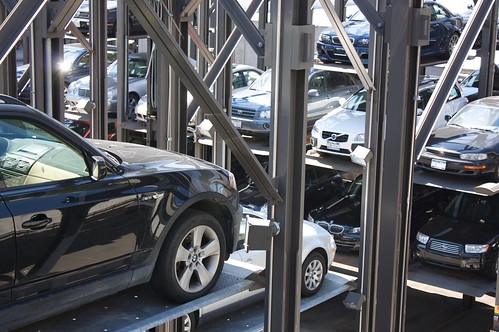
(photo by Adam Franco on Flickr)
Another way to look at the argument is to scale it up. Thought experiment: a fleet buyer is buying 100,000 vehicles. Imagine the difference between placing an order for 100,000 new hybrids vs. buying 100,000 used cars. Which is going to make the manufacturers sit up and take notice--and maybe even invest in new factories? In fact, what if that fleet owner put in an order for 100,000 every year? Oo, there's an interesting twist. Counterintuitively, by making that argument writ small we learn that buying a new efficient car every year is better than buying one and making it last. And it's true (although not practical for most people). It would send an even stronger economic signal to manufacturers.

In the end, the decision about replacing your car includes a lot of factors, not the least of which is your own personal financial situation. But if you're thinking about a new car, but have considered a used car for environmental reasons, think again.

BTW - Slate did a comparison that also comes out in favor of the new Prius even without invoking my macroeconomic and macro-environmental arguments.

Disputing David Sokol's Article on Cap and Trade

Today's Washington Post printed an op-ed by David Sokol, Chairman of the Board of Iowa-based MidAmerican Energy Holdings Co., a subsidiary of Berkshire Hathaway (article here).

His basic premise is that he believes cap and trade will cost an enormous amount and will attract schemers from the financial markets--and we know what they've done lately. In fact, he says we will pay twice: once to purchase allowances and once to build out the low carbon energy system. He may be right that the costs will be high, and most certainly there will be entrepreneurs of all types working to make money as our energy economy changes over from high carbon to low carbon. Some of them are likely to be "greedy," no less. I have trouble following his argument about paying twice, though. Under cap and trade, a regulated entity either buys emissions credits OR reduces its emissions through investments--not both. In the early years, the cap will be very close to existing emission levels, so the only utilities that may have to pay are the ones that rely heavily on fossil fuels, which is how it should be. In order to reduce the use of fossil fuels, we need to increase the costs of using it. The market will then decide if they want to pay the cost or find another way of making the electricity.

Most bizarre, though is his solution. I quote directly from the article:
"The solution? Keep the cap and remove trading from the equation: Mandate that the industry, over the same 40-year period, simply limit its emissions to the same levels proposed in the Waxman-Markey bill. This can be accomplished with a clear plan that gives states an option: Either they participate in a cap-and-trade program or they elect an alternative compliance mechanism to reach the same greenhouse gas emission goals by working with their utilities to develop a 40-year program of shutting down aging coal plants, retrofitting plants to capture carbon dioxide if the technology comes available, and /or building zero-carbon energy plants."

Huh? I thought he just said no cap-and-trade, and then he goes on to say that is one of the options.
Hypothetical: So I'm a state that has to make this choice. Well, why would I not participate in cap and trade? Either it's going to cost me more to get there through retrofits--in which case I'd rather trade for those allowances--or it's going to cost me less, in which case I would want to participate in order to sell my additional reductions and make money. Also, the trading part is entirely voluntary. If I, as a utility, want to just reduce my emissions to exactly my cap without trading either way, well then I can do that. So his second option is already available to anyone who wants to follow that path.

For me, I cannot see how a cap without trading will not cost more than the same cap with trading. Trading allows for the lower cost emission reduction strategies to be more effectively used, because they can occur anywhere and then credited in places where costs are higher. Without trading, each entity has to reduce its emissions regardless of costs, and those with lower costs have no incentive to go beyond its requirements.

Thus, without trading, no entity has any incentive to go beyond the minimum requirement and it costs more. With trading, clever entrepreneurs, technologists and others have a big incentive to go beyond the minimum requirements, thereby unleashing the creative forces that will propel us forward faster, and it costs less. Will some people get rich in the process? I hope so, because that will then attract more entrepreneurs into the field trying to make money, too--all of which helps us meet our goals better and faster.

The whole idea of cap and trade is that it does not dictate a pathway. The private sector is unleashed to figure out the most cost-effective ways to reduce emissions to the desired level (or below). For SO2 (the acid rain precursor), cap and trade has been a remarkable success, resulting in greater reductions at a small fraction of the expected initial cost for this very reason: the private sector figured out much cheaper ways to reduce emissions than were anticipated by anyone. Yet Sokol suggests that the state governments are going to be better and wiser about determining the pathway to lower emissions? State governments? Really?!?

Then we have the whole problem of state-by-state emissions. Washington state is low carbon due to its preponderance of hydroelectric plants. Virginia is high due to lots of coal. Who decides how that gets divvied up? Oh, maybe he's suggesting a nationwide average that can then be, well, capped and traded? How else? Any other option gets totally politicized with states arguing among themselves that their cap ought to be higher than yours, and on and on.

There is a simpler option, a simple carbon tax imposed way back at wellhead, coalmouth or wherever it is easiest to count and collect. That appears to be politically impossible right now, so the next best way to engage the creativity of the market is to provide incentives for them to take action: cap and trade.

Pedestrian Improvements in Greater Washington

Route 50 ped bridge from northwest It's almost done; ribbon cutting is scheduled for May 20. Even before I moved to a part of Arlington that is not far from Seven Corners, I was aware of the significant number of pedestrian deaths that were occurring along the stretch of Route 50 (Arlington Boulevard) near Patrick Henry Drive and Seven Corners (right by the Home Depot to point out a familiar landmark). Ped Bridge MapIt is the deadliest intersection in all of Fairfax County, accounting for approximately 25% of all pedestrian fatalities in the county: on average 2-4 per year. The county has known this is a problem area since at least 1987. I don't have the statistics, but extrapolating from known numbers, more than 50 pedestrians may have been killed here in the last 20 years. Here's a map of the area (one detail: the actual location of the bridge is somewhat west of what is shown. This is taken from the official VDOT site).

Creating separate pedestrian facilities is often not the best solution. What I, and many progressive urban planners believe is better, is to make our streets and roads more accessible, safer and more usable for all users: pedestrians, cyclists, Segway riders, and cars. Sometimes planners will create a poorly designed or planned pedestrian facility that will then "relieve" them of their responsibility to think more holistically about the interactions of road users. I agree with this viewpoint, but in this case, the pedestrian bridge at Seven Corners is a big, big improvement, and probably is the only reasonably safe enhancement that can be implemented in the short term. It also is located where pedestrians have generally wanted to cross and where many have been injured or killed.

Prior to the construction of this bridge, the only possible crossing points were at Patrick Henry Drive (not all that safe either: pedestrians have been killed in the crosswalk; the county has improved this crossing in the last couple years, but it's still a 6-lane highway) and Cherry Street, a distance of 1.3 miles from each other. Although one could cross at the Seven Corners overpasses, it requires a brave and fleet person to do so. There are no actual pedestrian facilities like sidewalks or lights there. So crossing at either Patrick Henry or Cherry St. requires a very long schlep, thus many people choose to make the mad dash across Route 50. For years the county tried to force pedestrians to the crossing at Patrick Henry rather than find a safe solution to their need to cross closer to their destinations.

There are homes, apartments and significant commerce on both sides of the highway, so there are lots of reasons for people to cross. One would think that the businesses would have an interest in making it easier for people to reach their establishments, too. I do not know if they were engaged in the project, though. On more than one occasion I have been in the Sunflower Restaurant looking out at the Guitar Center, seemingly close enough to touch--or at least hit with a golf ball. I measured with Google, and it's about 200 yards, so a golfer could conceivably hit one onto the Guitar Center roof from the restaurant. However, if I wanted to walk there, I could not do it. Impossible. Perhaps one could walk down Route 7 to Patrick Henry, cross there and go back up, a distance of 1.2 miles. I'm not sure there are sidewalks along this entire route, though.

By the new bridge, this distance is now still about 1/2 mile, but considerably more direct, doable and obvious to potential pedestrians.

So all in all, I believe this is a significant improvement. However, the county needs to continue to improve this area as well as the entire length of Route 50 inside the Beltway, where usable pedestrian crossings are few and far between. Here are my thoughts about this project:

- Way, way overdue, as mentioned above.
- It took a long time. This project was started in the fall of 2007. Originally it was supposed to be complete last November. Unfortunately, the original truss that was delivered was cracked, which caused a several-months delay.
- Why does the north side empty out inside the frontage road, so people still have to cross another lane of traffic to get to the sidewalk (see photos)? If the frontage road had been shifted a little southward, the bridge would need to be somewhat longer, but not much. They completely rebuilt this entire area, so it could have been designed that way. I often wonder why--when we're building a piece of infrastructure that will be there for 40 years or more--that more thought isn't put into these details.
- Pedestrian access on both sides needs to be addressed now that the bridge is complete. Completing well designed sidewalks and creating pedestrian access to cross the parking lots will make the bridge much more usable.
- There are still way too few ways to cross in this 1.3 mile stretch. Seven Corners itself needs to be rethought and redesigned to accommodate other road users besides cars (and it doesn't even do a very good job with those!) [Update: I learned at the ribbon cutting that this will happen in a couple of years.]
- It probably cost too much (I've read $2.6 million) [Update: I learned at the ribbon cutting that total costs were more like $8 million!]. Although it appears to be an excellent facility, Fairfax County is not known for its willingness to invest in bike/ped facilities. I suspect that the next time someone suggests an improvement, the county will say, "But that one at Seven Corners cost so much; we can't afford to spend that kind of money willy nilly on pedestrians."

I've also included a number of photos below, which you can expand by clicking. There's also a great article in the Falls Church News Press by Penny Gross describing the placement of the main bridge section a couple of weeks ago.

7 corners overpass 2 Taken in February from the Barnes & Noble parking lot prior to installation of the bridge (click to enlarge)


Route 50 ped bridge looking east from 7 corners 2 Looking east from Seven Corners. Home Depot is behind the bridge to the right (click to enlarge).

Route 50 overpass showing frontage road 2Looking West along Route 50. You can see the ramp pedestrians will come down and then have to cross the frontage road on the right to get to the sidewalk. Dumb. (Click to enlarge)

Route 50 overpass inside look

At the top of the ramp looking south across the bridge. Still a little work being finished up.

==========

(Cross posted with lots of comments on GreaterGreaterWashington)

Get a Grip! Swine Flu Hysteria

I sure wish we could figure out a way to harness the emotional energy associated with people's reaction to the new flu virus, and use it to help us transform our society and our world. Or, for that matter, engage our media at that kind of level.

This has been a page 1 story for days now. It is totally out of control and out of proportion. This blog (fivethirtyeight) reported about a study asking people if they knew someone who had gotten swine flu. 3.2% said they did! 3.2 percent!! They backed these numbers out to show that we'd need about 35,000 cases of swine flu for that many people to report they know someone with it, yet there are only a couple of hundred confirmed cases in the US. What is going on?

Here are some facts about this year's ('08-'09) flu season: the non-swine flu that has been circulating since last fall.

- Through its normal sampling testing, CDC has tested more than 25,000 positive specimens for flu, representing 14% of all samples they tested--indicating that literally millions of people have contracted the flu this season.
- 55 pediatric deaths have been attributed to the flu this season
- There have been at least two pediatric deaths every single week since the last week of January
- There were 10 pediatric deaths due to flu the week of February 28 (but no page 1 story; in fact, no story at all that I can recall)
- Just 3 weeks ago more than 7% of ALL deaths reported in the US were due to the flu. That would represent something like 3,000 people just in that one week.
- 13,000 people have died this year from flu
- In 2005, 63,000 Americans died of the flu. 63 THOUSAND!! Where were the news stories?
- Just two months ago 31 states reported "widespread influenza activity."

Today's Washington Post quoted a woman named Beth Pendergast:
"I heard this morning that a toddler died in Texas. And now, suddenly, there's a case in my back yard," Beth Pendergast, whose daughter Danielle is a third-grader at Folger, said late yesterday. "To be honest, my family is scared, and I'm scared. Even though they're taking all the precautions, it's still my child. At this point, there's no way I'm sending her to school tomorrow."

HELLOOO! Did she keep her child home all winter long, too? Children were dieing every week from the flu, and presumably other children in her kid's school had it. At this point there is no indication that this particular virus is either more contagious nor more virulent than the dozens of other flu viruses currently in circulation. In other words, people should take the same precautions and behave the same way now as they do during any winter month when flu is going around. (Be careful crossing the street, too.) This stuff drives me nuts.

How can we get a person like Ms. Pendergast equally engaged on fighting global climate change? In the end, the world her child grows up in will be far more affected by climate change than by this flu virus. And it's likely it will have a greater affect on her child's health and life expectancy, too--not to mention her quality of life as well.

On the other hand, it makes for some mighty fine entertainment and insights:
MinnPost
TechCrunch
Swine Flu vs. Financial Panic

LEED Accredited Professional and Green Buildings


I am pleased to report that last week I took and passed the exam to become a LEED Accredited Professional (AP). LEED is the certification system for green buildings created by and managed by the US Green Building Council. There are many programs and certifications for green buildings that have sprung up over the last couple of decades, but LEED is the most well recognized in the United States. By passing the test I demonstrated my understanding of the LEED certification process, the criteria to certify a building and a basic understanding of green building practices and technologies. (Although I will note that anyone with enough time to cram a bunch of information into their head could probably pass the test. . .at least until now: they are currently changing the certification process for the future.)

What the US Green Building Council and other organizations (such as EPA's Energy Star Buildings program) are doing to transform the built environment is critical in the battle against climate change. Buildings are responsible for 35%-40% of greenhouse gas emissions and use more than 60% of the electricity generated in the US. They have an enormous environmental impact. What's great is that the technologies and practices to make a huge improvement in the energy performance of buildings is already out there. Organizations like LEED, with the help of practitioners like me (hopefully), can help accelerate the adoption of those technologies and practices and help transform the buildings sector.

Efficiency Good; Hyperbole Bad

The Monday, April 20 Washington Post included an 8-page "advertorial" insert called Environmental Leadership--presumably in anticipation of Earth Day (not available on line). It included about a dozen guest articles on a wide array of environmental topics. Great! (although one of the advertising supporters is the American Coalition for Clean Coal Electricity, which promotes the oxymoron "clean coal." You can read more about my opinion of carbon capture and storage here.)

One of the guest writers is Nancy Sutley, the new Obama administation Chair of the White House Council on Environmental Quality. Her column runs the gamut, touching on a wide array of environmental issues--the normal rhetoric one would expect--but I stopped when I read this line: "We plan to put a million plug-in hybrid vehicles on the road, dramatically increasing the fuel efficiency of our nation's fleet of vehicles with batteries built in the U.S."

"Dramatically increasing?" Let's do a quick back of the envelope. In 2006 there were 234 million cars and light trucks on the road representing an average fuel economy of 20.30 mpg. Let's make some optimistic assumptions:
- Plug-in hybrids are the equivalent of 100 mpg
- All 1,000,000 new hybrids replace SUVs (average 18 mpg)

If we use 2006 as a proxy, replacing 1,000,000 SUVs with plug-in hybrids, then the new fleet economy rises to 20.38 mpg, an minuscule increase of .08 miles per gallon. Or put another way, an increase of about 425 feet per gallon. Another way to achieve the exact same reduction in fuel consumption would be to reduce the distance each car drives by about 50 miles per year--a 0.4% decrease.

Now don't get me wrong: I am totally in favor of transforming our economy to more environmentally sustainable technologies and systems, but I think a hyperbolic statement like this sugarcoats the magnitude of the challenge in front of us.

Let's put those million vehicles out there, but it's just a down payment. I think it would have been much better to say, ""We plan to put a million plug-in hybrid vehicles on the road, a small but important first step in transforming our nation's fleet of automobiles"

Smart Grid Requires Smart People

The "Smart Grid" is an enormously popular topic these days. I just ran a Google News search on the term "smart grid" and it returned almost 2000 hits (roughly the same number as a search on "ted kennedy"). The Obama administration has pledged at least $4 billion to funding the "smart grid."

What exactly is the smart grid? Well, it's one of those terms that's pretty broad and includes a lot of concepts. . .and can mean different things to different people. Basically, as I understand it, it's the combination of technologies and data management that will allow operators and users of our electrical grid to have better information about what is happening to the electricity that is passing through the grid or that they are using. That can include everything from simple home-based meters to multi-million dollar software for utilities to manage second-by-second transmission and distribution of electricity. Lots of companies are working hard to put the technologies and other tools out there that will make the "smart grid" work.

The rhetoric we hear often attributes significant environmental efficiencies to the smart grid. What's important to realize is that making the grid smart does not automatically make it more efficient. You need smart people and smart policies to combine with the smart grid to achieve any transformation. Better information by itself is not a goal, but merely a means to help achieve our goals.

Here's a real-life example. About 10 years ago I had a friend who signed up for time-of-use rates through his local utility (time-of-use rates do not require a smart grid, but many of the stories I read in the media suggest that the smart grid will make these more common). He paid much lower rates at night and in the winter and higher rates during the day and in the summer. What he found was that his off-peak rates were so low that it made sense for him to leave his lights on all night to help warm the house. Since his utility primarily burned coal as its baseload fuel, he was fuel switching from natural gas to coal by being "smart." In the process he was actually increasing pollution.

Without policies that send the right pricing signals to utilities, they could easily design "smart" rates that actually move generation away from higher priced peaking natural gas plants (and even higher priced renewables) to lower priced coal and nuclear.

I'm all for the smart grid, but not without smart people and smart policies to make sure that the information that it provides actually serves the purpose of reducing emissions and encouraging efficiency and cleaner generation.

Carbon Capture and Storage: A Solution?

Carbon capture and storage (CCS) is constantly in the news these days. A Google search on that phrase returns 1.2 million hits. There are cheerleaders and detractors on both sides of the technology, many with very strong opinions.

A very quick primer on CCS:
Carbon capture and storage is a technology--still in its infancy--that can capture CO2 emissions at the source (typically a power plant). It captures these emissions, liquidizes the CO2 and stores it in underground formations. Usually the underground storage is the same as where oil and gas has been extracted , which supporters argue will be able to store the CO2 for millenia. Wikipedia does a pretty good job of explaining it.

The point of CCS is to reduce the greenhouse gas emissions associated with burning fossil fuels by capturing them. Other major strategies for reducing greenhouse gas emissions include: reducing the need for energy in the first place (efficiency and conservation); replacing fossil fuels with other sources of energy (e.g., biofuels, renewables, nuclear), and biological sequestration (e.g., forests).

There are currently no commercial-sized CCS power plants in operation anywhere in the world, and critics also point out that the investments in CCS would have to be enormous to scale it up enough to be effective. However, I am in favor of continuing to invest in CCS; here's why.

As I opined in my post on nuclear power, climate change is happening way faster than scientists expected just a few years ago. The challenge is enormous, and our response to date has been insufficient to the challenge. At this point in time we need to go down every pathway, trying every strategy and investing in all the possibilities. We do not have time to scratch our heads over a perfect response to climate change; we need to do it all. On every front: renewables, efficiency, international agreements, alternative fuels, etc., we are coming up short compared to what is required to slow down and reverse the dangerous buildup of greenhouse gases in our atmosphere (I like the Climate Progress blog for the role it plays in educating about the severity of the climate crisis).

I do not believe that CCS should be used as an excuse to continue burning as much coal as we do now (or even more as the coal industry would like us to accept). Just the opposite; I believe we need to slow down and eventually stop the burning of coal. CCS needs to be developed as a solution to the main problem--not an excuse for not doing other things. On this point, I am closely aligned with the Union of Concerned Scientists viewpoint as outlined in this report.

I very much like the idea of developing CCS as a way to suck CO2 out of the atmosphere. When the technology is developed, it could be applied to biomass power plants (sometimes referred to as Bio-Energy CCS or BECCS). The CO2 captured would then result in a net reduction in CO2 from our atmosphere, essentially carbon negative (first the trees or plants remove the CO2 as they grow, then we capture that and store it away when we combust it for energy). That's something we have to do if we believe, as I do, that we already have too much in our atmosphere. Just slowing and stopping greenhouse gas emissions will not be enough; we also have to go backwards and reduce the 200-plus-year buildup of them.

So that's why I support CCS. If the fossil fuel industry can be used to help us develop the technology so that we can deploy it later in ways to pull CO2 out of the atmosphere, then I want it--and we need it--to happen.

Congestion Charge, Commuter Tax and Metro

Dc_traffic(Rerun - Originally posted Nov. 17, 2007) Last week a Washington Post reader named Bill Suffa wrote a letter to Dr. Gridlock in which he suggested that:
1) a congestion charge is essentially nothing more than a commuter tax and,
2) that Metro would be incapable of handling the extra ridership that would be created if a congestion charge for the district (or a portion of it) were enacted.

On point 1, I suppose he's essentially right, although "commuter" would include anyone who enters the congestion zone regardless if they are a resident of DC or not. My personal opinion is I don't see a problem with that. If the District wants to charge people for using its infrastructure (roads, bridges, etc.) then why not? Would it be good policy? Personally I think it would be, but others will disagree. There would be trade offs between raising money and driving away business, maintaining and improving infrastructure and irking suburban commuters, environmental advantages to reducing car traffic and other benefits and costs. I don't pretend to know what the right balance for the District would be, but I do maintain that they should have the right to decide for themselves, and I would suggest that if Fairfax County or any other jurisdiction wanted to charge for the use of its infrastructure, too, it should have that right.

On point 2, the challenges facing Metro have been written about a lot. Just recently it was reported that ridership has grown by 70,000 riders per day over the last 5 years (WMATA press release). Crowding on the system is getting worse despite new rail cars and eight-car trains being introduced. Mr. Suffa has experienced this himself, as have thousands of other riders. I doubt anyone would disagree with the statement that Metro service can be improved and capacity needs to be increased.Congestion_sign

London put #'s 1 and 2 together. A significant part of the reason London was able to enact a congestion charge was that they simultaneously invested more money into buses and trains to make it easier to travel in London without having to drive in. It was part of the plan.

Newnats_aerial_581x376We can take a lesson, too, from the new Nationals Stadium. DC was able to float more than $600 million in bonds to finance the stadium from taxes that haven't yet begun to be collected and will continue for many years. London collects an estimated $244 million per year from its congestion charge and estimates for DC start at $60 million per year. Using similar financing rates to the stadium deal (and assuming between $60 million and $244 million per year were collected), if the congestion tax were dedicated to WMATA, bonds could be floated for between $900 million and $4 billion--money that could be put to work immediately to make significant improvements. Using the stadium strategy would allow for starting the improvements in advance of instituting the congestion charge, increasing the capacity needed before it is required.

Land-Use Transformation to Reduce Teenage Deaths (a Personal Plea)

I am terribly saddened by the death of my brother's and sister-in-law's niece, 16. She died last week, several days after a severe car accident that was survived by the three other teens who were in the car. She was a passenger in the rear seat. I don't know all the details of the accident.

There are, of course, reams and reams of statistics on teen driving accidents and scientific research in neurology and sociology that try to explain some of this. Many states have taken actions such as progressive licensing, driver training, seatbelt laws, and more to protect our teenagers essentially from themselves and their friends--and not without some results. Teenage driving deaths have declined over the last fifteen years.

However, thousands of teenagers continue to die in car accidents every year, and teens will always be more likely to have accidents than others no matter what we do, because of their inexperience as drivers and their not-yet-completely-developed judgment. This second point is not a criticism of teenagers; it's a neurological fact. When it becomes personal, though, all of this information is meaningless. My family has lost a loved one, a piece of our lives that cannot be replaced.

Everywhere I read about the teenage driving "epidemic" (if it were a disease killing thousands of teenagers every year, imagine the response of our government), the solutions are always about changing licensing, rules, training, parental responsibility, etc. Never do I read about changing society so that teens (and others) just don't need to drive--or as much.

A significant part of this problem lies in the way we have created our urban and suburban forms. Teenagers want to have fun; they want to be with their friends; they want to take advantage of things going on in and around their schools and communities. In most communities, however, the only way they can do these things is to drive or be driven. This blog is about transformation--primarily to reduce our environmental impacts. But transforming the way we develop our communities will provide so many additional benefits, too.

If our teens could easily walk or take the bus or rail to where they want to go. If they could safely bike to their friends' houses and to the local shops and theaters. If the fun stuff they want to do was accessible to them. I believe not only would that improve the quality of their lives--and their parents' lives, but it might save hundreds of their lives, too. Somehow we have to change the culture, too. Driving is cool to many teens; I can't change that in the short term. In the long run, though, perhaps we can.

The way we design and develop our cities and our transportation systems has to change. We are not on a sustainable path: not environmentally sustainable, not culturally sustainable, not economically sustainable. My brother's niece is gone. . .forever. Another 10 teens will die today in auto accidents. As the father of a 15-year old, I'm not in favor of limiting our childrens' opportunities as a solution (one of the criticisms of raising driving ages and graduated licensing). Instead let's re-create our land use forms and our transportation systems in ways that make our lives better AND safer AND less resource intensive all at once.

R. S. vT., may you rest in peace.

War on Drivers forces capture Kensington, MD; Weiss counterattacks

The ongoing "War on Drivers" (WoD) in the DC area took a major turn last week, as WoD forces captured Kensington, Maryland. They've announced plans to destroy all automobiles, furnishing every resident with free bicycles and walking shoes instead. An immediate counter-attack, led by General Eric Weiss of the "Not-Til-You-Pry-It-Out-Of-My-Cold-Stiff-Hands" (NTYPIOOUMCSH, pronounced Nitty-pyoo-miksch) expeditionary forces and and with tactical support from the VDOT Third Armored Road Repaving Division, bombed Clarendon with a flurry of unsubstantiated studies indicating the need for four new elevated freeways crisscrossing the county but not actually leading anywhere.

NTYPIOOUMCSH encountered resistance on their rush from Virginia to defend Kensington by numerous bottlenecks on I-66. Weiss remarked, "See, this is what we mean! If we can't even get our Hummers and Expeditions where we need to in order to engage the enemy, then it just proves our point. This is all-out war!" However, his forces took to the local roads in Arlington, and executed a coup-d'etat against Arlington's Governor-of-Urban-Canopy, Christopher Zimmerman, who took refuge in the Pentagon City Metro station—a safe location the NTYPIOOUMCSH forces were not aware even existed.

WoD forces, strengthened by the fresh air and exercise they were now getting, began spreading their influence to the south, and met with a friendly ally in Bethesda, where similar battles were also being waged. The WoD forces were aided by the significant mobility advantages provided by the secret Metro tunnels, bike paths and pedestrian connections that do not appear on NTYPIOOUMCSH's Goggle maps.

As usual, the on-line community was instantly engaged, and updates on the war can be found on the WoD supporters' Facebook page: "Make 'em walk 'til they blister" and twitter at ntypioumcshsucks. Countering in cyberspace, the enemy created their own Facebook page: "Get outta my frickin' way" and are also tweeting at outtamyfrickinway.

It's still too early to tell how the war will end, with each side claiming to hold the high ground and unwilling to back down until the other side quits moving about in an "uncivilized" fashion. Both sides had tentatively agreed to peace talks by former President Jimmy Carter, but negotiations broke down over disputes as to whether he would travel to the region by car or Amtrak.

(Photo by Jason Means.)

(cross-posted on Greater Greater Washington)


New Model for Transportation - Take 2

My post from last week: We Need a New Model for Expanding Transit received a long, thoughtful response from Paul Minett: Co-founder, CEO and President at Trip Convergence Ltd. He was responding not to my post here but to my sending similar thoughts to an industry list serve called transp-tdm (TDM stands for Transportation Demand Management, and there is a whole industry of professionals who work in this field). I have edited Paul's response slightly, but have hopefully captured his thoughts and ideas:

Well said, Steve. And since you asked, here is what I think. I think the score card you propose is all wrong. This is not (or shouldn't be) a 'cars vs transit' issue, nor should it be a 'vehicle miles per gallon' issue. Eventually we will be forced to restructure how we achieve 'accessibility', and how much 'mobility' we actually need. In the meantime switching cars for buses or trains is like the proverbial 're-arranging the deck chairs on the Titanic': eventually they all become obsolete.

It has been suggested (by
Jonathan Levine, for example) that 'accessibility' is made up of 'proximity', 'connectivity', and 'mobility'. We get what we focus on, and while the focus is on 'mobility' that is what results. A concerted effort to improve 'connectivity' could reduce the need for so much 'mobility'. On the other hand, within 'mobility' sits vehicle occupancy.

It amazes me that when some people look at a jammed freeway they see the solution being to add more vehicles (ie buses). There is enough rolling stock already out there. And it could all be getting 100 passenger miles per gallon, just by filling up the empty seats. We recently got almost 200 passenger miles per gallon on a trip from Portland to Salem: four people in a Prius.
Eventually we must reduce the amount of 'mobility' we consume.

In the meantime we need to put lots of thought (and action) into strategies that increase average vehicle occupancy, and reduce total vehicle counts, and reduce the amount of 'solitary mobility' we consume. Possibly the most energy efficient transport available is the van owned by a worker who carries eight or ten co-commuters for most of its journey, and then parks up while the worker does his job, until doing the return journey.

Highly efficient buses that deadhead empty to collect the next load are only half as energy efficient on a per passenger mile basis as the same buses operating full in each direction. During peak the loadings might justify the deadhead, but outside of peak it becomes questionable.


As a starting point we could all focus on mechanisms to increase the rewards for sharing rides, increase the cost of driving alone, and simplifying the process of sharing rides. We are one of many businesses focused on finding solutions to make progress in this area, and it is not plain sailing. Many seem to be offended that private companies might make a profit in this space. But perhaps more to the point, we find a lack of discretionary time and budget in the offices of the organisations that should be interested in working with us. And when there is funding for innovation the processes to bring it about are complex and very slow. Only the most dedicated stay the course.


I think it is great that you have opened up this discussion. I hope others will find time to comment because this is a fundamentally important issue.


Thanks, Paul, for your ideas and helping to push the transformation to sustainability this blog and millions of others seek.